
Using AI in private hard-money lending offers a wide range
of benefits beyond simply automating loan documents and expediting underwriting.
The advantages extend past time savings, often helping you secure better
loans—or loans that may have been unattainable without AI.
Assists
you in presenting your loan scenario honestly while highlighting its strengths
for lender evaluation
Host
competitive bidding among top lenders.
Submit
individual loan applications to each lender for multi-lender bidding.
Provide
regular updates on progress at every stage.
Offer a
centralized platform for document uploads and distribution to multiple lenders.
Identifies
the most suitable hard money lenders based on your specific situation
Solicits
loan quotes from various lenders
Compare
these quotes to find the best option
Explains
the pros and cons of each loan proposal to support informed decision-making
Clarifies
hidden conditions or restrictions within any loan quote
Negotiates
with lenders to improve loan terms
Tracks all
communications
Researches
and verifies lender reputations
Use AI
insights on hard money loans to ensure legal compliance.
This article examines how AI can
negotiate with multiple lenders to secure more favorable loan terms. Successful
negotiation requires both a thorough understanding of the subject and strong
negotiation skills. Hard money loans are complex, involving considerations well
beyond just rates and terms—which are seldom among the top three priorities.
For those skilled in negotiation, this article outlines when and what to
negotiate. However, for individuals who prefer to avoid negotiation yet still
seek optimal outcomes, AI advancements now enable automated solutions. It is no
longer necessary to have an in-depth understanding of AI or prompt engineering;
selecting the appropriate AI tricky money agent is sufficient.
Compare and negotiate offers from
multiple lenders.
Why
you should negotiate any loan
Well-qualified borrowers are
expected to negotiate with lenders, as negotiation is integral to any loan
transaction. When approached professionally,
you, being an effective negotiator, can yield
substantial savings or leverage the AI revolution to have it negotiate on your
behalf.
Residential Fannie/ Freddie,
FHA, USDA, and VA loans should be carefully compared and negotiated, in
accordance with CFPB
guidelines, which suggest comparing offers from three to four lenders and
can yield estimated savings of approximately 1%. Due to the highly fragmented
nature of private hard money lending, evaluating and negotiating terms with
multiple hard money lenders may result in savings of 4% to 7%, as opposed to
working with a single lender without negotiation.
Priorities
in negotiations
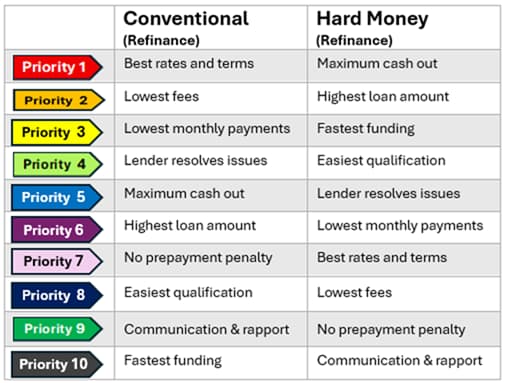
Hard-money
borrowers' 1st priority in securing a loan is never the Best Rate and terms;
otherwise, it is no longer a hard money loan. Priorities sequence varies by loan and situation.
Fastest funding is common, 1st
priority for private loans, but it can
be any of the 10 priorities below
Comparing
vs Negotiating loans
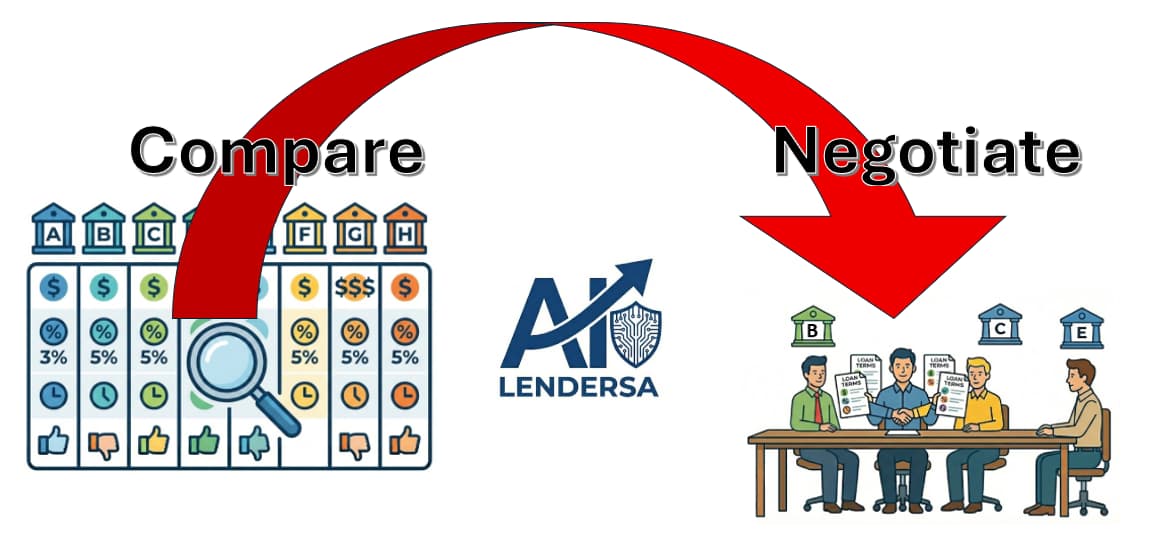
The process of comparing loans
is distinct from negotiating loan terms, though the two are frequently
connected. When managed effectively, this combined strategy can yield
substantial financial benefits.
With AI, comparing loan quotes
becomes effortless. The borrower receives information on the strengths and
weaknesses of each quote, helping organize the data for successful
negotiations.
Always wait until you have
received a written quote before entering negotiations. A Soft Quote should outline
all the lender’s approval conditions, detail the required documents, and
provide estimates for both approval and closing timelines. Compare these
details with your own requirements.
If you receive only a verbal
quote from a bank or institution, make sure to put it in writing for use by the
AI during your comparison step.
Enter the data from your
negotiations into a spreadsheet, then use ChatGPT to analyze and compare the
best loan offers. Be sure to review all the loan conditions carefully—sometimes
an attractive quote comes with requirements you can't meet, such as needing two
years of tax returns you don't have. You'll need to renegotiate or remove such
terms.
You can also use Lendersa agent 3.2 for
automated comparisons, as it integrates ChatGPT with sophisticated prompts that
are not possible to replicate manually.
When to
negotiate
Loan negotiations can only
happen after you’ve secured the interest and preliminary commitment of lenders.
Attempting to negotiate before this point is not only unproductive but might
also discourage a promising lender from working with you.
Prior to commencing
negotiations, a borrower seeking private financing typically narrows down their
options to three or four lenders from a larger pool of interested parties.
Identifying and engaging the most reputable hard-money lenders is a crucial
component of this process, and we have dedicated a blog post to providing comprehensive information on this topic.
What to
negotiate:
Loan
amount or LTV: The loan
amount can be crucial. If the lender offers 60% LTV but you need 65%, this is
worth discussing.
Qualification requirements: These may include completing the loan
process by providing only bank statements or obtaining approval even if a
co-borrower has a poor credit history, among other possible scenarios.
Speed of closing: If a specific deadline for funding is
required, the promptness of closing becomes more critical than rate and terms.
Conversely, allowing the lender additional time for document review and
thorough inspection can result in more favorable rates and terms.
Conditional
Approval: Certain properties—such as
commercial real estate, vacant land, or those valued over one million
dollars—can present appraisal challenges. It is advisable to negotiate the loan
amount and other related terms if the appraised value differs from the lender’s
original estimate.
Points: Negotiating between 0.25 and 0.5
points is generally acceptable.
Rate: While you can try for a better rate,
it's not crucial on short bridge loans. Prioritize getting the right loan
amount, points, and terms; if those are satisfactory, consider asking about the
rate—but don't insist too much and focus less on interest.
Terms: Always request longer terms, since 12
months is often too short. Aim for terms between 18 and 36 months.
Extension
Fee: If possible, negotiate for
automatic extensions without extra fees or try to reduce extension costs.
Prepay
penalty: Avoid accepting a loan with a
prepayment penalty lasting the entire duration. Try to limit penalties to no
more than three or six months. You may need to pay an additional fee to remove
the prepayment penalty, which is worthwhile if you know your payoff date.
Appraisal: Many lenders request their own
appraisal, but you can try negotiating with a Broker Price Opinion (BPO) or a
recent appraisal report from a different lender. If it's a purchase or the
loan-to-value ratio is very low, you might persuade the lender to skip the
appraisal altogether, which can significantly expedite the closing process.
Escrow and Title: Lenders who typically prefer to
utilize their own escrow or title companies may be persuaded to consider an
existing open escrow to expedite the process, or to accept a current title
report that has already addressed any discrepancies.
How to Negotiate with Lenders
Well-qualified borrowers are
expected to negotiate with lenders, as negotiation is integral to any loan
transaction. When approached professionally, effective negotiation may result
in substantial savings.
Two
negotiation methods are:
A. Emphasize key strengths of
the loan application
B. Compare approval offers from
other lenders
Both methods should be applied
when there are competing lenders.
From lenders' perspective, the
principal concern with hard money loans is not simply ROI but
security—specifically, the assurance that capital can be recovered if the loan
defaults. While hard money lenders are prepared to acquire the underlying
property in the event of borrower default, this action is typically considered
a final measure to recoup invested funds.
Generally, regardless of loan-to-value ratios,
lenders will refrain from extending credit if they anticipate significant risk
associated with either the property or the borrower. Consequently, applicants
are advised to present the strongest aspects of their loan applications to
demonstrate, unequivocally, the security of the proposed loan. The following
examples illustrate how borrowers can highlight the strengths of their loans
during negotiations:
Exceptional
property location, such as proximity to major landmarks (e.g., within 100 yards
of the new City Mall, offering a superior 270-degree ocean view)
Low
Loan-to-Value (LTV), for example, less than 65% LTV or only 55% LTV supported
by an MAI appraisal
Excellent
credit scores, such as an 820 mid score, or all borrowers having scores above
750
Clear and
uncontested exit strategies, such as multiple offers to purchase the building
ranging from $2.5 to $2.8 million
The local
real estate market is showing signs of improvement; for instance, according to
the Wall Street Journal, property values in Miami Beach are projected to
increase by 7% next year.
Property
value growth is assured; for instance, we've secured a 10-year lease with the
City of Orange, or already have two interested tenants for the two-bedroom
apartment.
A proven
track record is crucial for rehab, construction, or fix-and-flip loans.
Describe your recent rehab project and highlight the profits you earned by
successfully resolving permit issues or engineering challenges.
By strategically presenting
these and similar qualities, borrowers can strengthen their negotiating
position with lenders.
Ideally, if you have two or more
lenders who are very interested in your loan, you can use favorable terms from
one lender as leverage when negotiating with another to secure a better loan
offer.
More Negotiation
Tips
Experienced lenders often
respect borrowers who negotiate assertively for better loan terms, as this
suggests responsibility and a lower risk of defaulting. While it's important to
advocate for yourself during negotiations, avoid making excessive demands or
constantly shifting your requests, as this could jeopardize the process.
Respond promptly to any calls
from the lender and provide all requested documents to maintain clear,
effective communication.
Always be honest about your
income, expenses, and credit. If lenders discover any false information during
underwriting, they will end the process.
Disclosure requirements for hard
money loans may vary; in some cases, disclosure of income and financial
circumstances is not mandatory. If the lender does not request specific
information, there is no obligation to provide it proactively.
Appraisal Issues—With hard money
loans, the property's value is central to loan approval. However, an appraisal
report provides only an opinion of value. In purchase transactions, the
purchase price is typically the most reliable indicator of property value,
provided the transaction is conducted at arm's length and there are no
conflicts of interest. The lender must still request an appraisal to ensure you
are not paying above market value.
When soliciting valuations from
ten different appraisers for a refinance loan, one can expect to receive ten
distinct assessments of value. For tract homes, the variance among appraisers
typically falls within a 10% range; however, for commercial properties, land,
and custom homes valued above $1 million, discrepancies may reach up to 30%
between appraisers.
Negotiation Mistakes That Can Ruin Your
Best Chance.
Even if just one lender
expresses interest in your loan, you can aim for a better deal by negotiating
with them. Be ready to walk away if necessary, then search for other lenders or
reconsider their offer.
Many hard money lenders are
private investors or rely on funds from individual investors. These investors
can be unpredictable, though they typically act rationally. They might agree to
finance a borderline loan if they have a favorable impression of you. However,
if you anger them with unreasonable negotiations, they will quickly withdraw
their support.
Keep in mind that you'll often
encounter loan officers eager to assist you to earn their commission; however,
they are not the ultimate decision-makers when it comes to approving your loan.
For this reason, a written loan approval signed by the lender is
more reliable than verbal promises from loan officers. While loan officers may
not intentionally mislead you, they might not have all the information and
often present the most optimistic scenario to encourage you to proceed and pay
for an appraisal.
Do not pay for an appraisal
unless:
A. You have received a signed
written term sheet from the lender.
B. You have researched the
company and obtained references about their performance from independent third
parties.
Leveraging
AI for lender negotiations
Loan Negotiation is not an
option- it is an important step in getting a loan. The question is do you want
to do it yourself or let the AI do it for you
AI can help you negotiate with
lenders more effectively. You have the option to handle talks on your own or
use AI to do the negotiations for you. agent to assist you. The AI reviews conditional approvals, comparing
them to each other and to industry standards for similar loan requests. Next,
it drafts an email highlighting key negotiation points for you to approve and
send to your lender. For successful AI-driven negotiations, provide a precise
prompt along with complete details about your loan request and the offers from
lenders.
You could use AI agent like
Lendersa 3.2 to prepare emails to each lender with key points you wish to
negotiate. The AI will customize separate
emails to each lender, containing the issues the AI deemed worth negotiation.
Ultimately, it is still more
effective
through a Zoom or phone call.
Lendersa AI is designed to
secure better loan terms by using its built-in prompts and all relevant data
about you, your property, each lender’s quotes, and every communication you’ve
had. Your role is simple: click “Negotiate with [Lender Name],” and if you’re
satisfied with the AI’s draft, just hit send—the message goes instantly through
the portal.



