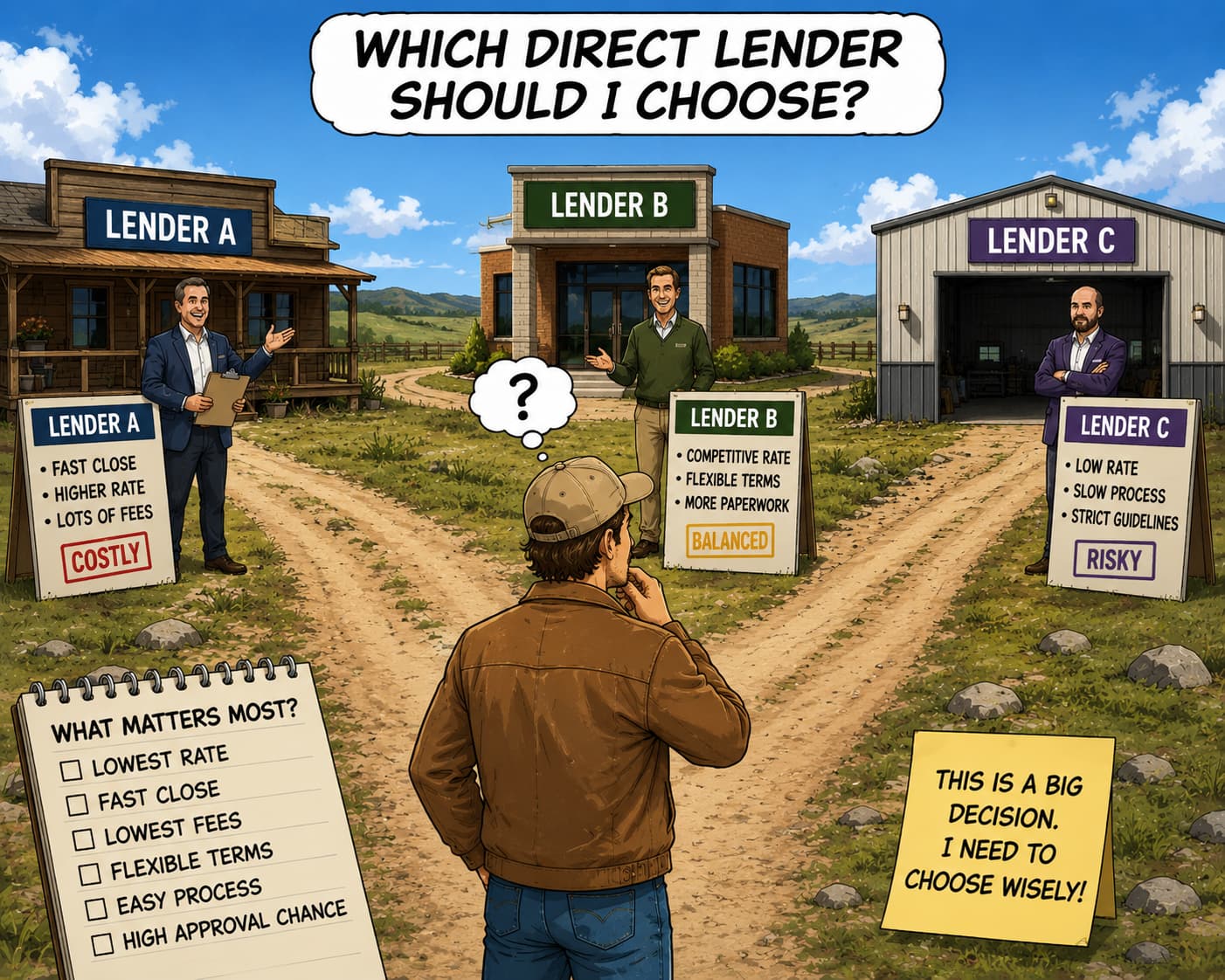
This document explains the significant differences among various real estate loan providers—including banks, credit unions, Fannie Mae, Freddie Mac, FHA, private hard money lenders, insurance companies, and CMBS lenders—highlighting the importance of shopping around, comparing loan estimates, understanding lender-specific criteria and overlays, and considering factors such as rates, terms, fees, underwriting standards, and lender types to find the best loan fit for borrowers' specific needs.
Brokers: How much time are you wasting trying to find the right hard money wholesale lender for a tough client scenario? ⏱️ Chasing down lenders, managing scattered emails, and comparing complicated LOIs takes you away from what actually matters: closing the deal and serving your client. We just published a fully transparent guide breaking down the 16 BEST Direct Hard Money Lenders in the industry—and we even included their direct phone numbers and emails. 📞✉️ You can contact them one by one, or you can see how Lendersa® lets you reach all 16 (plus hundreds more) in about 5 minutes.
Every real estate investor wants to cut out the middleman to save time and money. While going straight to a 'Direct Lender' is the holy grail for many, skipping the broker isn't always the smartest move. Here’s why direct hard money lenders are in high demand, when a broker might actually save your deal, and how to instantly shop both in California
Securing a hard money loan requires understanding a completely different framework than traditional bank financing. Rather than focusing primarily on personal income, private lenders prioritize the asset. This comprehensive guide breaks down the "5 Master Factors" determining your hard money rates and origination fees. It begins with Property Factors, highlighting how Loan-to-Value (LTV) reigns supreme, alongside property type, condition, and income. Next, it explores Borrower Factors, noting that while credit matters, an investor's track record and exit strategy carry more weight. The guide also details essential Loan Features like duration, prepayment penalties, and funding speed, before examining the motivations behind The Lender ecosystem (local vs. national, brokers vs. direct lenders). Finally, it addresses macro Market Influences, such as local real estate trends and economic shifts. Ultimately, while baseline national averages provide a starting point, completing a customized loan scenario is th

Lendersa AI enables you to identify suitable lenders, compare loan offers, and monitor your loan progress until funding and closing. The advantages of utilizing this platform include: • Discovering lenders that closely match your loan requirements • Receiving competitive offers from multiple lenders • Comparing loan terms and eligibility criteria efficiently • Easily tracking multiple loan offers in one place • Potentially saving thousands of dollars annually by securing lower interest rates • Reducing the risk of fraud by avoiding unscrupulous brokers • Securing loans even after being informed elsewhere that approval would be unlikely • Successfully facilitate the closure of loans that other lenders deem "impossible to close" • Lendersa services to consumers are provided entirely free of charge
This blog gives instructions on getting a loan request approved by multiple lenders or improving the quality of a loan for better approval. This blog applies to general hard money loans. For Fix N Flip loans, construction, or vacant land loans, we have specific instructions and advanced calculators.
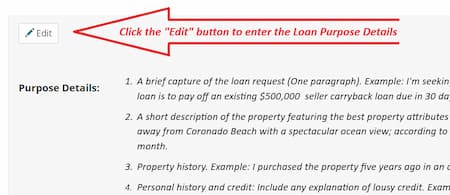
Uploading documents will save you hours of explanation. Find out which documents are required, and which are usually requested.Get examples of what to say and what information to provide your lenders to save hours of explanation and fast track your loan for review and approval.
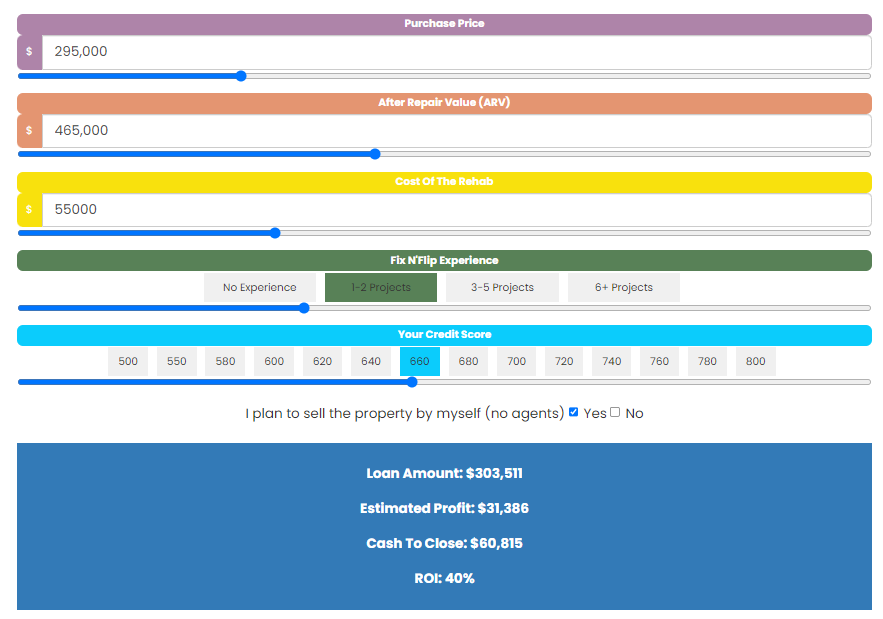
Lendersa Fix and Flip calculator finds the most money you can borrow on your Fix N' Flip project based on the purchase price, ARV, rehab costs, credit, experience, and property location. Each State is a little different because of property tax insurance and regulations.
Discover the pros and cons of direct hard money lenders in our latest blog post. Learn more about direct hard money lenders today. Direct hard money lenders provide loans directly to the borrower, cutting out the need for a mortgage broker. This can be advantageous for those looking for quick financing or who may not qualify for traditional bank loans. Working with a direct lender can streamline the borrowing process and provide more flexibility in loan terms. However, it's essential to carefully research and compare options to ensure you are getting the best deal for your financial situation, especially when it comes to the application process.


Commercial real estate investors and business owners often find themselves in need of additional funds to finance property improvements, purchase new assets, or expand their business. In such cases, a commercial equity loan can be a viable solution. By leveraging the equity they have built up in their commercial property, borrowers can access a lump sum of cash to meet their financial needs. A commercial equity loan is similar to a commercial cash-out refinance, as both involve refinancing the property to access funds. However, while a cash-out refinance provides a one-time, lump sum amount, a commercial equity loan allows borrowers to access funds as needed. This flexibility can be beneficial for businesses that have varying cash flow requirements or for real estate investors who may need funds for property rehabilitation or acquisition. To secure a commercial equity loan, borrowers need to evaluate their property's equity, gather the necessary documentation, and apply with multiple lenders to compare
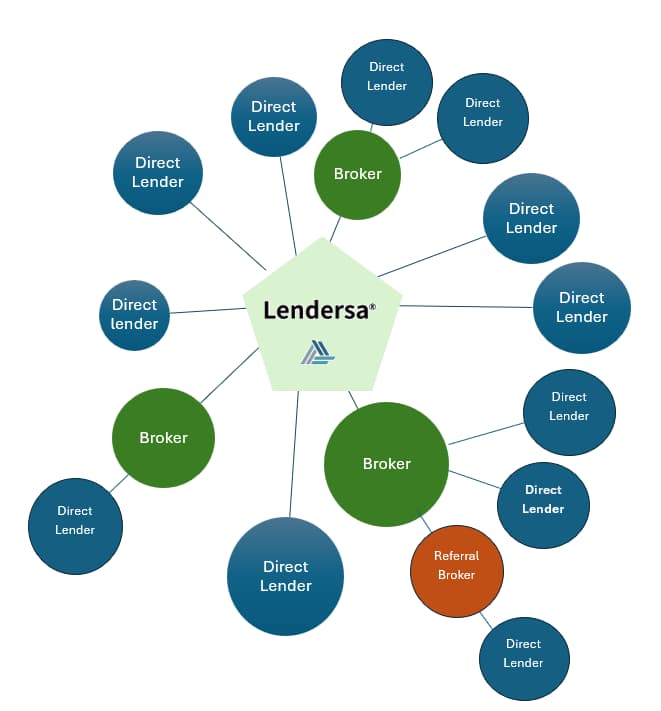
Find out the different types of lenders and how they interact to fund hard money loans. This blog sheds light on the web of brokers and lenders cooperating to fund a private hard money loan and their relationship.
Understanding how Lendersa works for borrowers is critical to your success. Thousands of lenders could potentially fund your loan, and we want to ensure that only the best lender with the best rate, terms, and loan conditions you fulfill quickly is elected to fund your loan. Conventional loans, FHA, Commercial loans, SBA, Vacant land loans, and Hard money loans are all being done with the help of Lendersa AI, and they all follow the same steps described in an information blog.
Comprehensive guide which highlights the importance of using direct hard money lenders in Florida to bypass intermediary brokers, ensuring faster underwriting, direct capital control, and certain execution for real estate deals. It provides a curated directory of 20 verified private, asset-based lenders actively funding fix-and-flips, ground-up construction, and DSCR rental properties across the state. Features structured tables and detailed FAQs to help property investors compare direct financing against traditional banking routes. Ultimately, it emphasizes leveraging a competitive loan marketplace to streamline property analysis and secure optimal financing structures.
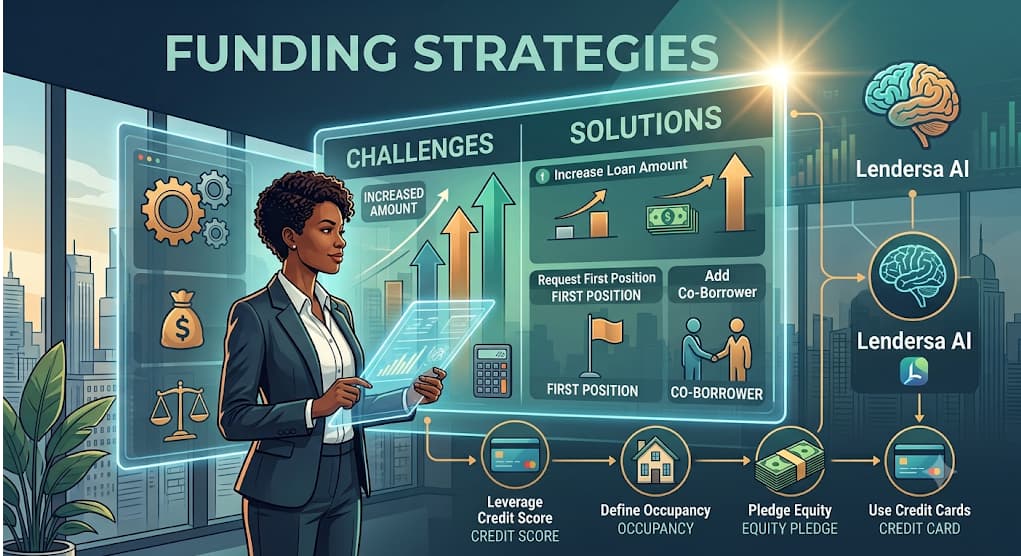
Securing a small real estate loan under one hundred thousand dollars is difficult due to low lender profit margins, strict regulatory caps on closing costs, and legal risks. Because underwriting a small loan takes the exact same effort as a large loan, traditional and hard money lenders routinely reject them. However, borrowers can overcome these hurdles by using the AI matching platform from Lendersa. Effective strategies include increasing the loan request above the minimum threshold, requesting a new first position loan, adding a strong partner, leveraging high credit scores, pledging additional collateral, or strategically utilizing personal credit cards for funding.
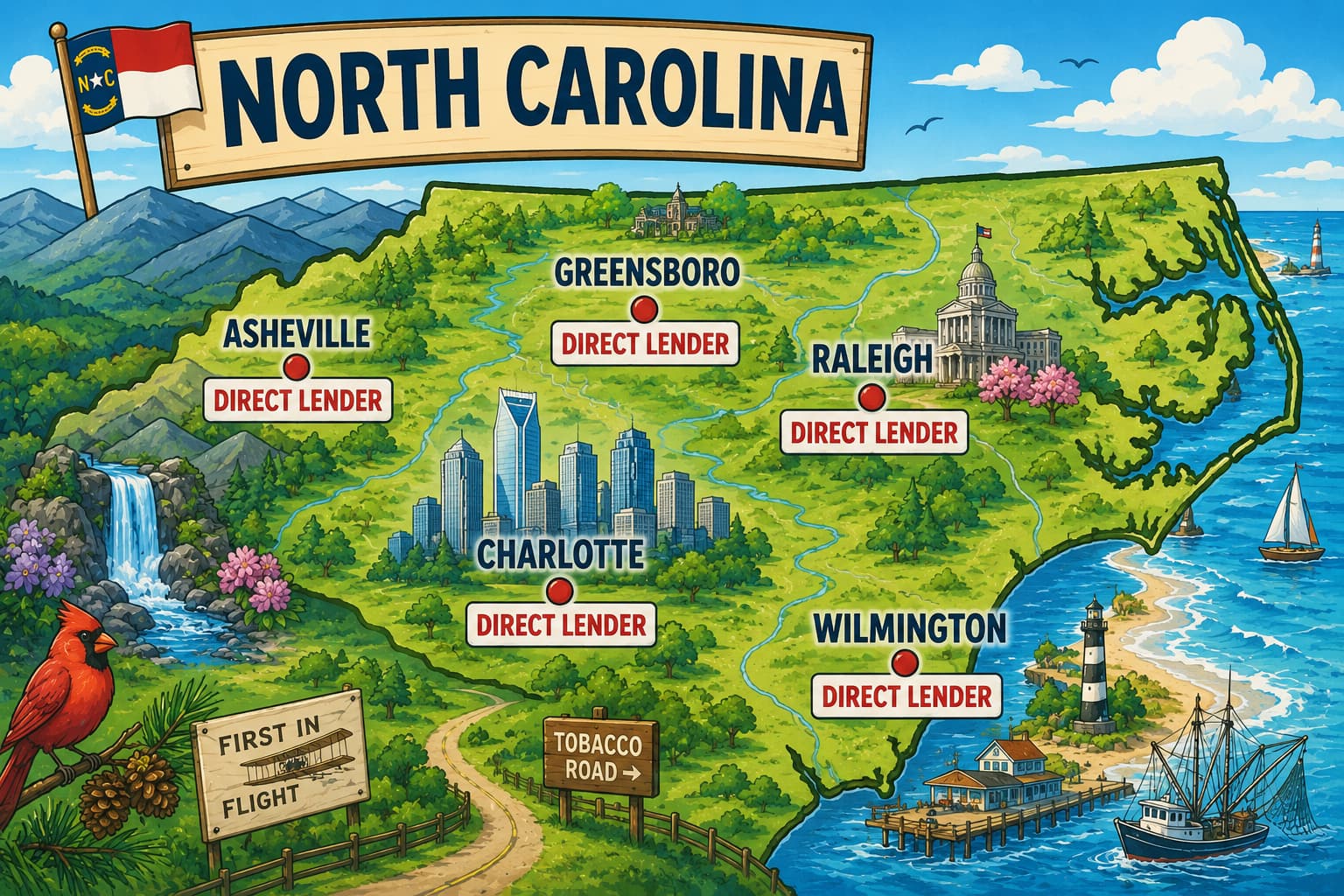
Naming 11 top direct hard money lenders in North Carolina with overviews for each. Giving a hard money cost comparison and overview.
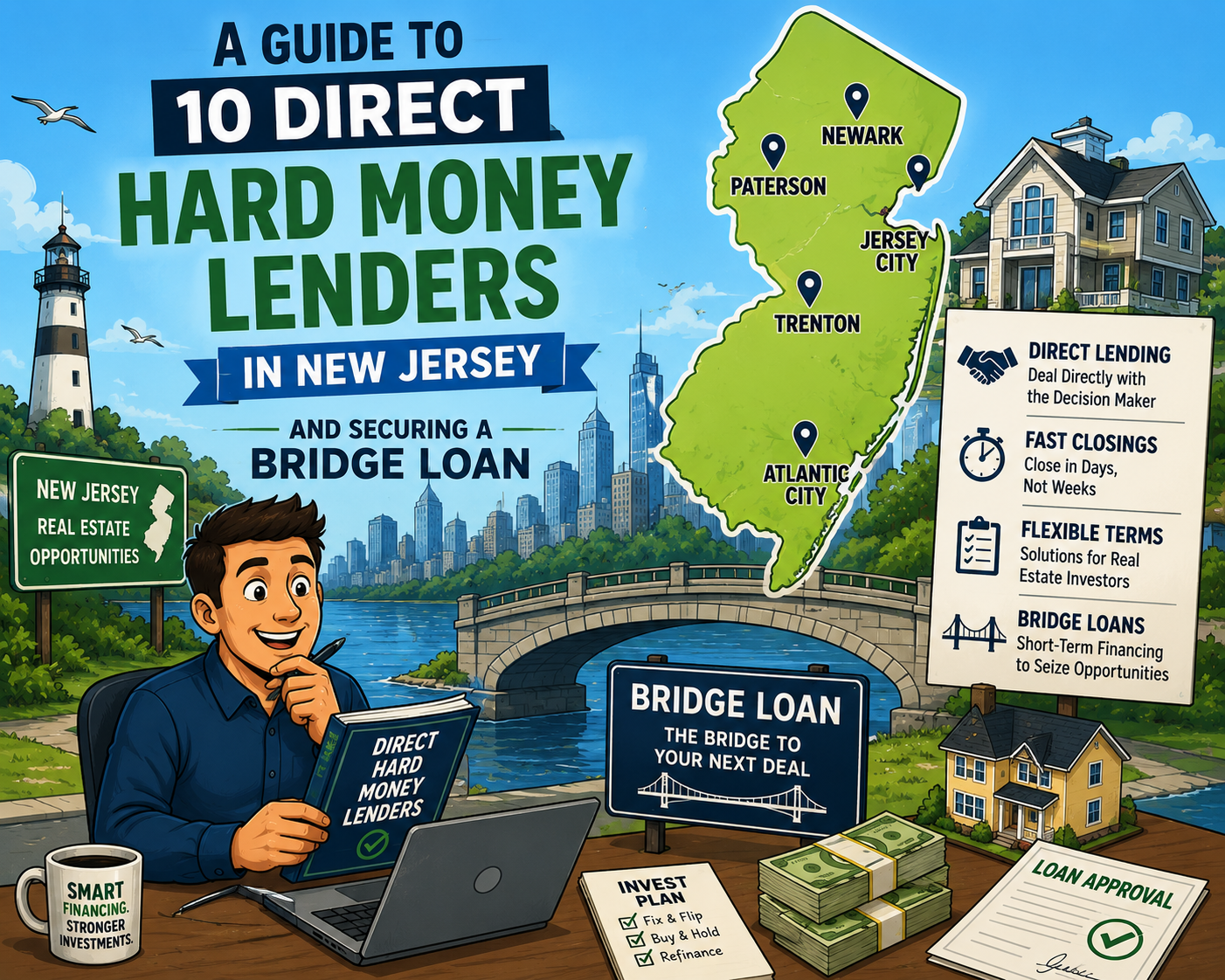
This blog provides a comprehensive guide for real estate borrowers and investors seeking direct hard money lenders in New Jersey. It explains the mechanics and benefits of commercial bridge loans, highlighting typical 2026 terms such as interest rates and fast closing speeds . The guide breaks down the four-step process of securing a bridge loan, compares direct lenders to traditional banks, and features a curated directory of 10 top direct lenders actively operating in New Jersey.
In Georgia’s fast-moving real estate market, timing is your entire margin. This comprehensive guide equips real estate investors, developers, and landlords with the exact private funding strategies needed to close deals rapidly without traditional bank delays.
The article addresses the frustration of losing time-sensitive real estate deals to cash buyers by introducing Illinois investors to the speed and flexibility of direct hard money lenders. It provides a quick-reference table to match specific investment strategies—such as Cook County flips or suburban rentals—with the most appropriate capital providers, followed by a detailed directory of 29 lenders actively operating in the state. To help borrowers secure the best terms, the guide offers expert advice on navigating Illinois' judicial foreclosure laws by preparing detailed scopes of work and strong exit strategies, ultimately concluding with an FAQ and a call-to-action to use an AI-powered marketplace to instantly compare loan offers.
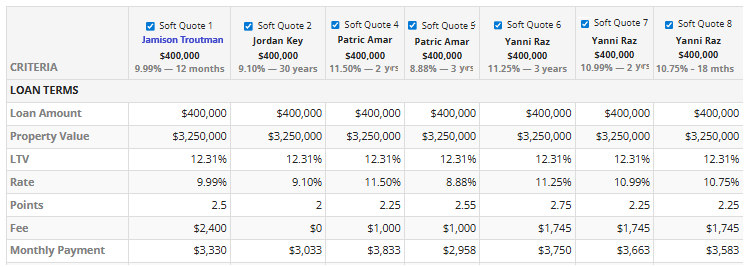
This guide provides borrowers with a step-by-step tutorial on how to maximize their Lendersa® loan request. After submitting a request, borrowers should aim to collect "soft quotes" from interested lenders so they can easily compare their options. The tutorial covers how to navigate the Lendersa® dashboard to review lender pitches , the importance of communicating directly through the platform's private messaging system to secure the best possible offers , and how to properly evaluate both the loan terms and the qualification requirements. Additionally, it highlights how to use Lendersa® AI to instantly sort and compare 10 or more loan offers based on personal priorities , along with crucial safety cautions like avoiding upfront payments before securing a quote.
This blog post serves as a comprehensive guide for real estate investors and borrowers seeking direct hard money and private capital lenders in Pennsylvania to fund fix-and-flip projects, ground-up construction, DSCR rentals, and commercial acquisitions. It provides a curated directory of 14 vetted lending firms—highlighting local Pennsylvania-headquartered boutique lenders alongside select national platform lenders—complete with loan amount ranges, loan types, phone numbers, and web addresses
This blog post serves as a comprehensive resource for real estate investors seeking reliable private capital in Ohio's thriving property market. It outlines 21 verified direct hard money lenders, thoughtfully balancing localized Ohio-headquartered boutiques with dominant national platforms. To streamline the borrower experience, the article features an executive quick-reference table that directly matches specific real estate strategies—such as fast Columbus fix-and-flips, Cincinnati ground-up builds, and statewide DSCR rental portfolios—with the lenders best equipped to fund them.
Securing commercial real estate loans between $10 million and $100 million requires moving beyond traditional banking. This comprehensive guide explores the complex landscape of mega-cap private lending. It breaks down how underwriting evolves at the eight- and nine-figure levels, including the strategic use of equity kickers to fund high-risk or early-stage assets like raw land subdivisions and high-tech data centers. Borrowers will learn the critical differences between direct lenders, brokers, and hybrid funds, as well as the red flags to watch for to avoid costly execution risks. Finally, the article introduces Lendersa’s proprietary AI matching agent. By helping developers craft an institutional-grade Executive Summary, Lendersa creates a secure, blind-auction environment. This technology forces top-tier capital sources to compete for the deal simultaneously, ensuring developers secure the best leverage and rates while maintaining total privacy until they are ready to move forward.which pairing you choos
In the fast-paced world of real estate investing, funding speed can make or break a deal. Our latest article, "40 Fast-Closing Hard Money Lenders," is your ultimate guide to securing capital in seven days or less. We break down LTV requirements for a rapid close and explain the critical differences between direct lenders, brokers, and hybrid lenders. While we highlight 40 excellent nationwide examples, relying on a single capital source is a fatal mistake. Lendersa’s network actually comprises over 600 active local lenders—private investors who intimately understand their own markets and can frequently outspeed the big national names. To save your sanity, we reveal how to use Lendersa’s free, AI-powered dashboard to effortlessly juggle multiple lenders, selectively share documents, and instantly compare competing offers side-by-side. Read the full guide to discover the smartest way to fund your next real estate investment
Target Audience: Real estate investors, house flippers, and landlords frustrated by traditional bank delays and invasive income verification. Primary Objective: To educate borrowers on how asset-based lending (Hard Money and DSCR) works, and to provide a clear, actionable blueprint for organizing their files to successfully close a loan in one week using the Lendersa platform.
If you are searching for the 'best Non-QM lenders' or the 'top DSCR lenders,' you have probably realized that no single lender is the 'best' for everyone. A lender offering the lowest DSCR rate for an 800-credit score investor might reject a 640-credit score flipper entirely. > That is why searching for lenders manually is a broken system. Instead of guessing which lender's box you fit into, Lendersa® acts as your ultimate cheat code. Our Artificial Intelligence doesn't just give you a list; it instantly scans the guidelines of over 200 Non-QM and Hard Money lenders nationwide to match your specific scenario with the absolute best rate and terms
Manual lender outreach limits options and slows down commercial borrowers, while AI loan matching platforms instantly connect you to better, more competitive loan offers.
This article gives borrowers a practical checklist for evaluating private lenders. It covers red flags such as hidden fees, pressure tactics, unclear terms, and unusually expensive or one-sided loan structures. The guide helps readers compare legitimate private lending against predatory or illegal lending practices before moving forward.
This page explains how real estate investors can shop hard money lenders and compare rate ranges, points, and fees using soft‑inquiry or no‑inquiry tools instead of immediate hard credit pulls. It highlights what information lenders use to quote terms (collateral type, loan‑to‑value, experience, exit strategy), how typical hard money pricing bands look, and when a full application with a credit check becomes necessary to lock a final offer.
This playbook shows borrowers how to position their deals so multiple private money lenders actively compete to fund them. It covers how to package your property, numbers, and exit strategy, how to present the same information to all lenders, and how to compare offers beyond just rate (points, fees, draws, prepayment, and flexibility). The guide is designed for real estate investors who want to turn lender competition into concrete savings and stronger, more reliable funding.
This article shows real estate investors how to shop hard money lenders and compare rate ranges, points, and closing costs without triggering a hard inquiry. It explains what information lenders can use to generate soft quotes, how to read preliminary offers versus final term sheets, and when it makes sense to move from rate‑shopping to a full application. The guide is designed for borrowers who want fast funding while keeping their credit profile as clean as possible during the search.
This page presents a borrower-focused scorecard that ranks commercial loan matching platforms by how well they help real users get from deal idea to closed transaction, not just from form to “matches.” It highlights key factors such as number and type of lenders covered, quality of lender–deal fit, transparency of terms, and the level of packaging and advisory support each platform provides for real-world commercial real estate and business finance scenarios.
This article walks real estate borrowers through a practical, step‑by‑step framework for evaluating private lenders. It explains how to verify registration and licensing, review interest rates and fees, assess contract clarity and enforcement clauses, and recognize high‑pressure or predatory behavior. The goal is to help borrowers quickly sort legitimate private lenders from risky or potentially illegal loan sharks before they commit to a deal.
This article helps Texas real estate investors secure the best asset-based financing by comparing the pros and cons of direct lenders versus brokers, introducing Lendersa's competitive marketplace, and providing a comprehensive contact directory of 30 top hard money lenders in the state.