Comparing loans SIDE
BY SIDE: why and how
We sought to determine whether lenders
vary in their approach to loans secured by real estate. To this end, we engaged
AI to address the question of whether differences exist among various loan
providers—including Fannie Mae, Freddie Mac, FHA, commercial real estate
lenders, credit unions, banks, private hard money lenders, life insurance
policy loans, and CMBS loans. The results were clear: there are significant
distinctions among these lenders. The distinction is not only among different types of loans; even
lenders offering the same loan type can vary, leading to different outcomes.
For example, five lenders arranging the same FNMA loan for the same client at
the same time could each provide a different loan approval.
The AI
consistently emphasised the importance of carefully comparing formal loan
proposals (Loan Estimates) from various lenders, including banks, credit
unions, and mortgage brokers.
Conclusion: Borrowers should shop around with different
approved lenders to compare rates and approval criteria.
If it is crucial to shop around and carefully
evaluate your options when selecting a loan,
four considerations remain:
A. Where to find the lenders
B. How to effectively communicate your
loan needs
C. How to obtain a loan quote from
lenders without a loan application?
D.
How to compare loan quotes?
Where
can I find lenders?
Solution: Lenders are widely available.
Search
online using your loan type and location, e.g., "Lender for refinancing a
house in Los Angeles, California."
Useful
portals include:
yelp.com
(lender reviews)
Lendersa.com
(private hard money lenders)
zillow.com
(local lenders)
bankrate.com
(rates and calculators)
Ask
friends, family, or your real estate agent.
Request
help from an AI assistant.
What is an effective method to
talk to lenders about my loan needs?
Solution: Aim to reach out to 5 to 15
lenders—the more, the better. The most effective approach is to prepare a
written loan request that you can email or text to each lender. In order for a
lender to give an initial idea of what kind of loan they can offer, they'll
need details about the property, your finances, your credit history, a short
explanation of your loan’s purpose, and how you plan to repay it.
If
you don’t have this information ready, you’re likely to spend hours on the
phone before finding out whether a lender can actually help you.
Lendersa.com
offers a free, standard loan request form accepted by most lenders, providing
all the essential details needed for them to give you a definite answer. This
comprehensive form helps you receive a quick quote and does not require any
confidential information, such as your Social Security number. The Lendersa form is simple to use and
available at no cost. You have the option to print it as a PDF or send it
electronically to your chosen lender. Start a loan request to show your
lenders
Warning: Do not fill out any Loan Application
If
a lender whom you have just begun working with requests that you complete their
loan application immediately, it is advisable to refrain from doing so at this
stage. While submitting a loan application is a critical step in the approval
process, it is important first to understand the specific type of loan being
offered, along with its rates, terms, and the required documentation. Without
this information, you risk investing significant time into applications that
may not serve your needs, and you may encounter unnecessary follow-up calls and
credit inquiries, which can adversely affect your credit score.
How to obtain a loan quote from lenders without a loan
application?
Solution:
After you deliver your loan request to a lender, request a written loan quote.
A loan request is enough for a loan officer to give a soft quote, which you can
compare with others. Ensure that you provide the loan officer with precise
details regarding the property and your financial circumstances. It is
important that the credit score information is accurate; you may obtain this
online without affecting your credit. If you are aware of any possible concerns
related to your credit, income, or the property, document these issues in your
loan request and address them directly with the loan officer to prevent
unforeseen complications. Even if a
lender can't provide a written quote, they may offer a verbal one. Make sure to ask what verifications and
documents are needed for any quote.
How to compare loan
quotes?
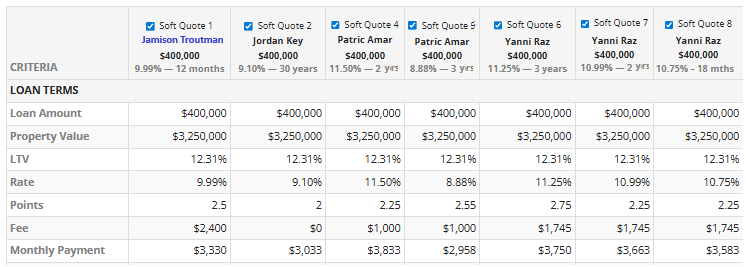
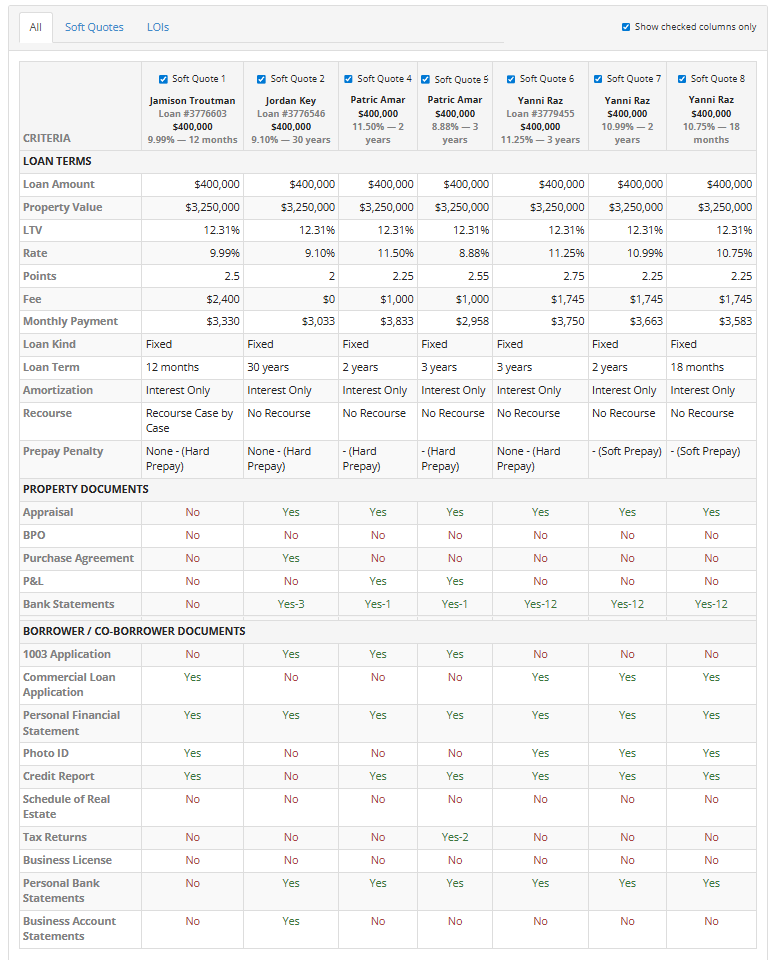
Solution: Comparing loan quotes
can be tricky. It is not only the rate
and terms, but all other factors:
Loan duration (Conventional loans typically
30 or 15 years, Private/ Hard Money Loans
6 months to 3 years)
Rate ( most critical on long-term
loans could be less important than other factors on
short-term interest-only loans)
Amortization ( is the loan interest
only or amortized over what period?)
Monthly payments (Different from the
rate, depending on the amortization period)
Loan Points (Percentage of the loan
amount, Lender discount point, and broker points)
Fees (fixed amount for documents and
processing)
Prepay penalty
( Could be more important than the Rate or
point if you plan to pay off the loan soon)
Balloon/ Extension (For Private / Hard
Money loans and certain commercial loans)
Other Loan Features ( Convertible loans, or
loans with fund control or other features that must be compared)
Appraisal (is the lender using a
3rd party appraisal, an in-house appraisal, or does not even require
an appraisal)
Time for approval (Full approval is
normally after an appraisal is completed; you may ask for approval, subject to
appraisal)
Time to close (Some loans can take
weeks between approval and close -find
out)
Minimum credit (The better the credit,
the better the loan)
Required documents (This could be a
killer, e.g., the lender requires 2 years' tax returns and you don’t have
it)
The lender's reputation (A very attractive loan
quote can become a disaster if the lender is incompetent or, god forbid, a crook)
Start a loan request to find competing lenders
Side-by-side comparison
Are there differences
among lenders who arrange Fannie Mae loans?
Yes,
there can be differences among lenders in loan approvals even for loans
intended for sale to Fannie Mae.
While all lenders must adhere to the minimum eligibility and
underwriting standards set by Fannie Mae, individual lenders have some
discretion and can impose stricter criteria or use different processes.
Factors Causing Differences
- Fannie Mae Minimum Standards: Fannie
Mae establishes baseline requirements for all loans they purchases,
including minimum credit score (generally 620, though this can change with
updates to the guide), maximum debt-to-income (DTI) ratio (typically up to
50%), and property standards. Lenders must meet these minimums, but they
are free to require more.
- Lender "Overlays": Many
lenders impose their own, more stringent requirements on top of Fannie
Mae's guidelines, often called "overlays". For example, a lender
might require a minimum credit score of 660 even if Fannie Mae's minimum
is 620, or demand more cash reserves than Fannie Mae requires. These
overlays are a business decision by the lender to manage their own risk.
- Underwriting Methods: Lenders can use Fannie
Mae's automated underwriting system, Desktop Underwriter (DU), or conduct
a manual underwriting process. While DU provides a comprehensive risk
assessment within Fannie Mae's guidelines, manual underwriting allows for
more interpretation and subjective decision-making within the lender's
internal policies, potentially leading to different outcomes.
- Operational Capacity and Risk Tolerance: Smaller lenders might work with investors or aggregators who
handle underwriting and secondary market sales, potentially leading to
different approval experiences than working with a large direct
seller/servicer. Lenders also have different internal quality control
programs and risk management frameworks that can influence how strictly
they apply guidelines.
- Product Offerings: Some lenders may offer
specialized Fannie Mae programs, like HomeReady mortgages, that not all
lenders actively promote or participate in, leading to variations in
available options for specific borrowers.
In
essence, a loan denied by one lender might be approved by another, provided the
loan meets all the baseline Fannie Mae requirements, because the second lender
may not have the same "overlays" as the first.
Start a loan request to find
competing lenders
Freddie Mac Guidelines
Freddie
Mac establishes baseline criteria for the loans it will purchase, known as
"conforming" loan standards. These cover various aspects of the loan
and the borrower, including:
- Credit Score: There is generally a minimum credit score
requirement (e.g., around 620 for conventional loans or 660 for Home
Possible loans).
- Debt-to-Income (DTI) Ratio: The borrower's DTI ratio is
evaluated to ensure they can afford the monthly payments.
- Property Standards: The property must meet certain
requirements for value, condition, and marketability.
- Documentation: Lenders must adhere to specific documentation
and underwriting guidelines, often using automated systems like Freddie
Mac's Loan Product Advisor.
Lender Overlays (Stricter Standards)
Individual
lenders often implement their own additional requirements, known as
"overlays," which are stricter than the base Freddie Mac guidelines.
A lender might do this as part of their own risk management process.
Examples
of lender overlays could include:
- Requiring a higher minimum credit score than the Freddie Mac minimum
(e.g., a lender might require a 640 FICO score when Freddie Mac allows
620).
- Setting a lower maximum DTI ratio.
- Demanding larger down payments or higher financial reserves.
- Having additional property condition standards beyond the basic
requirements.
Therefore,
a loan application that is denied by one lender might be approved by another,
even if both plan to sell their conforming loans to Freddie Mac, because of
these differing internal policies. Borrowers should shop around with different
approved lenders to compare rates and approval criteria. You can find more
details on general requirements in the official Freddie Mac Single-Family Seller/Servicer Guide.
Are there differences among lenders
who arrange FHA loans?
Yes,
there are significant differences between lenders offering FHA loans, primarily
in their interest rates, lender fees, and
specific underwriting standards (known as
"overlays").
While
the basic requirements for FHA loans are set by the Federal Housing
Administration (FHA), private lenders approved by the Department of Housing and
Urban Development (HUD) originate the loans and can add their own criteria and
pricing.
Key Differences Among FHA Lenders
- Interest Rates: The FHA does not set the interest rate; private
lenders do. Rates can vary "hugely" from one lender to another
based on their business costs, market conditions, and desired profit
margins.
- Lender Fees and Closing Costs: FHA mortgage
insurance premiums (MIP) are the same regardless of the lender you choose.
However, other lender fees and closing costs can differ significantly. It
is crucial to compare the Annual Percentage Rate (APR) on loan estimates,
as it reflects the total cost of borrowing, including fees and interest
rate, over the loan term.
- Underwriting Standards (Lender Overlays): Lenders can impose stricter requirements than the FHA minimums,
known as overlays.
- Credit Score: The FHA allows a minimum credit score of 580
for a 3.5% down payment, but many lenders require a higher score, such as
620 or even higher.
- Debt-to-Income (DTI) Ratio: While the FHA generally looks
for a DTI around 50%, some lenders may have a stricter maximum.
- Customer Service and Process Efficiency: The experience can differ based on the competency and knowledge of
the loan officers, processors, and underwriters. Some lenders may offer a
faster closing time or a more streamlined online experience.
- Available FHA Programs: Not all FHA-approved lenders
offer every FHA program, such as FHA 203(k) renovation loans or specific
down payment assistance options.
To
ensure you get the best deal, it is important to shop around and compare
official loan proposals (Loan Estimates) from several different lenders,
potentially including banks, credit unions, and mortgage brokers.
Start a loan request to find
competing lenders.
Banks, Private/Hard Money Lenders, Insurance companies, and
CMBS Lenders?
There are
significant differences between lenders for commercial real estate loans, which
can impact interest rates, terms, and the application process. Lenders can be
broadly categorized into traditional banks, non-bank lenders (including private
and hard money lenders), insurance companies, and CMBS lenders. Each type has
its own set of criteria, risk tolerance, and loan products.
Comparison of lender
types
|
Feature
|
Traditional Banks and Credit Unions
|
Private/Hard Money Lenders
|
Insurance Companies
|
CMBS Lenders
|
|
Speed
|
Slow; can take 45–90+ days.
|
Fast; can close in as little as 7–10 days.
|
Can be slow, similar to banks.
|
Often faster than traditional banks.
|
|
Interest Rates
|
Generally lower, as they have access to low-cost capital.
|
Significantly higher, reflecting the greater risk and
speed.
|
Competitive, similar to banks.
|
Competitive, particularly for long-term financing.
|
|
Underwriting Focus
|
Emphasizes borrower's credit, income, and financial
history.
|
Focuses on the property's value and potential
profitability.
|
Balances borrower's financials with property stability.
|
Focuses heavily on the property's income-producing
potential (Debt Service Coverage Ratio or DSCR).
|
|
Flexibility
|
Rigid loan terms and underwriting criteria.
|
Highly flexible, with customized loan structures
possible.
|
Can offer customization, but generally less flexible than
private lenders.
|
Less flexible once the loan is originated, especially
with modifications.
|
|
Recourse
|
Often require recourse (personal guarantees) from the
borrower.
|
Varies, but sometimes offers more flexible recourse
terms.
|
Varies.
|
Typically non-recourse, meaning the borrower is not
personally liable beyond the collateral.
|
|
Best For...
|
Established businesses with strong financials and time to
wait.
|
Investors who need to close quickly or have
non-traditional properties.
|
Stable, low-risk properties with long-term financing
needs.
|
Large, stabilized properties where a fixed-rate,
non-recourse loan is desired.
|
What is the difference between traditional banks and credit unions?
There
are significant differences between traditional banks and credit unions as
lenders, primarily stemming from their fundamental business models. Credit
unions are not-for-profit cooperatives owned by their members, while banks are
for-profit corporations owned by shareholders.
This
difference in structure means credit unions typically return surplus earnings
to their members in the form of lower interest rates on loans, higher yields on
savings, and fewer/lower fees. Banks aim to generate profit for their
investors, which can translate to higher costs for borrowers and
customers.
Key Lending Differences
|
Feature
|
Traditional Banks
|
Credit Unions
|
|
Profit motive
|
For-profit, focuses on shareholder returns
|
Not-for-profit, focuses on member benefits
|
|
Loan Interest Rates
|
Generally higher on average
|
Generally lower on average
|
|
Fees
|
Often higher fees for services
|
Generally lower or fewer fees
|
|
Lending Flexibility
|
Often rely on rigid underwriting criteria
|
May be more flexible and willing to work with members
with unique financial situations, as they consider the whole
picture/relationship
|
|
Loan Products
|
Tend to offer a wider variety of loan products,
especially large commercial loans
|
Strong focus on consumer loans (auto, personal,
mortgages) and may have more limited business loan options
|
|
Loan Servicing
|
Often sell mortgages to third-party servicers
|
More likely to retain and service the loans they
originate, allowing for a more consistent relationship with the lender
|
|
Membership
|
Open to the general public
|
Requires meeting specific eligibility criteria (e.g.,
living in a certain location, working for a specific employer, or joining an
affiliated organization)
|
Summary for Borrowers
- Choose a credit union if you prioritize lower
loan interest rates, fewer fees, and a more personalized,
community-focused service where you are a member-owner.
- Choose a bank if you prioritize a wider range of financial
products (especially complex investment or large business loans),
extensive branch and ATM networks, and robust digital/mobile banking
technology.
In
both cases, deposits are federally insured up to $250,000 (by the FDIC for
banks and the NCUA for credit unions), providing the same level of security for
your funds. It is always recommended to shop around and compare current rates
and fees for your specific needs before making a decision.
Start a loan request to find
competing lenders
Are there differences among commercial banks'
loans?
Yes,
there are significant differences among lenders offering
traditional commercial bank loans, primarily concerning their specific
underwriting criteria, interest rates, fees, loan terms, and customer
relationship models.
Key Differentiators Among Lenders
- Underwriting and Eligibility Criteria: While all traditional banks have strict requirements, they
vary in their specific metrics.
- Large vs. Local Banks: Large national banks often
have more rigid, standardized rules (e.g., specific credit score cutoffs,
minimum time in business), whereas smaller community banks or credit
unions might offer more personalized underwriting, considering a wider
range of factors or existing customer relationships.
- Debt Service Coverage Ratio (DSCR): Banks use DSCR as a critical metric (typically expecting 1.2x
or higher), but the exact required ratio can differ by institution and
property/business type.
- Collateral: Some lenders might place greater emphasis
on the value of collateral (asset-based lending), while others focus more
heavily on the business's overall cash flow.
- Interest Rates and Fees:
- Pricing: Due to different operational costs and risk
appetites, the interest rates offered by different banks for similar
loans can vary.
- Fees: Lenders may have different application
fees, origination fees, and prepayment penalties.
- Loan Products and Terms:
- Specialization: Some banks specialize in
certain types of commercial lending (e.g., equipment financing,
commercial real estate, SBA loans) and may offer more favorable terms or
expertise in those areas.
- Amortization and Maturity: Commercial loans often
have shorter maturity periods (e.g., 5, 7, or 10 years) with a balloon
payment, but the specific length of the term can differ among banks.
- Flexibility: While traditional banks are generally less
flexible than alternative lenders, some portfolio lenders (those who hold
their mortgages rather than selling them on the secondary market) may
offer slightly more flexibility with terms after establishing a
relationship.
- Application Process and Speed:
- Documentation: The required documentation
can vary slightly, with some banks demanding even more comprehensive
business plans and financial statements than others.
- Timeline: The time it takes to process and fund a
loan can differ significantly between banks, ranging from several weeks
to months.
- Relationship Model:
- Many traditional banks emphasize a relationship-driven approach,
providing a dedicated relationship manager and potentially offering
better terms or a wider range of integrated services (e.g., treasury
management, business checking accounts) to existing, long-term
customers.
Ultimately,
shopping around and comparing offers from multiple lenders is crucial for a
business owner to find the most suitable terms for their specific financial
needs.
Start your
commercial loan request to find competing lenders.
Are there differences among Credit Union
loans?
Yes,
there are significant differences in the commercial loan offerings among
different credit unions, as each institution tailors its services based on its
size, expertise, and community focus. Not all credit unions offer commercial
loans, and those that do vary widely in the types of loans, terms, and amounts
they provide.
Key
differences include:
- Availability: Commercial lending involves different, more
complex risks than consumer lending, and not all credit unions have the
necessary experience, skills, and resources to manage it. Smaller,
community-focused credit unions may not offer the full range of commercial
services that larger ones do.
- Loan Products: While most credit unions offer common
products like term loans, lines of credit, equipment financing, and
commercial real estate loans, the specific variations, terms, and
availability can differ. Some may specialize in certain areas, such as
U.S. Small Business Administration (SBA) loans.
- Loan Amounts: Larger credit unions can often accommodate
bigger loan amounts, while smaller ones might focus on the needs of local
small businesses and offer microloans or smaller-scale financing.
- Flexibility and Personalization: Credit
unions generally emphasize a relationship-based approach and may offer
more flexible underwriting criteria and personalized terms compared to
traditional banks. This flexibility can vary from one credit union to
another, with some offering tailored repayment schedules (e.g.,
interest-only payments, seasonal skip-payments) that align with a
business's cash flow.
- Rates and Fees: Due to their
not-for-profit, member-owned structure, credit unions typically offer
lower interest rates and fewer fees on loans than for-profit banks.
However, the exact rates and fee structures will vary between
institutions.
- Membership Requirements: To access commercial loans,
a business owner must first be a member of the credit union, which
typically involves meeting specific eligibility criteria related to
geographic area, employer, or association. These requirements differ for
each institution.
Therefore,
businesses seeking a commercial loan should research and compare different
credit unions to find one that offers products and terms that best fit their
specific needs.
Are there differences among Private/Hard Money Lenders?
Yes,
there are significant differences among private hard money lenders in
their rates, fees, terms, experience, funding sources, and general
business philosophy. These variations can significantly impact the
borrower's experience and the suitability of the loan for a specific
project.
Key Areas of Difference
- Source of Funds: Lenders may use their own
capital, funds from a group of investors, or institutional capital. This
affects their flexibility, reliability (especially in market downturns),
and the speed of funding.
- Lending Philosophy:
- Asset-Focused: Many hard money lenders
base their loan decision primarily on the value and potential resale of
the underlying property (the "hard asset"), rather than the
borrower's creditworthiness or income.
- Relationship-Focused: Other "pure"
private lenders (often individuals or small groups) may prioritize a
personal relationship and the borrower's experience and plan, offering
more flexible, negotiable terms.
- Loan Terms and Costs:
- Interest Rates and Fees: Rates typically range from
8% to 15% but can vary widely among lenders. Fees, such as origination
and appraisal fees, also differ.
- Loan Term Length: Hard money loans are
usually short-term (6 months to 3 years) for projects like fix-and-flips,
while some private lenders may offer longer terms.
- Flexibility: While hard money loans generally have
standardized, less negotiable terms, "pure" private lenders can
be very creative with loan structures and may be more willing to revisit
terms post-closing if issues arise.
- Regulation and Oversight: Hard money lending
companies are often licensed and subject to specific lending laws,
offering a level of oversight. Purely private individual lenders may not
be licensed, leading to less formal agreements and oversight.
- Experience and Specialization: Some
lenders are highly experienced with specific types of real estate
investments (e.g., fix-and-flips, new construction) and can offer valuable
guidance, while others may be less specialized.
Conclusion
Because
of these variations, it is essential for a borrower to thoroughly research
potential lenders, understand the source of their capital, and compare their
specific terms and requirements to find the best fit for their project. The
ideal lender will align with the borrower's specific needs and project
timeline.
Yes,
there are differences among lenders (insurance companies or
third-party premium finance companies) offering loans that use a life insurance
policy as collateral. These variations can affect the cost, terms, and
conditions of the loan.
Key
differences include:
- Interest Rates: Different lenders set their own interest rates,
which can be fixed or variable. While the rates on policy loans are often
competitive compared to other types of personal loans, specific rates can
vary among insurers.
- Loan Terms and Provisions: Lenders offer varying repayment
structures, potential penalties (e.g., for prepayment), and other
contractual obligations. Some lenders offer standardized loan products,
while others may customize terms based on the borrower's needs or the
policy's value.
- Maximum Loan Amount: While you can typically borrow
a high percentage of your policy's accumulated cash value (often up to
90%), the exact maximum percentage may vary by insurer.
- Collateral Requirements: The specific type and value of
collateral required, and how it is valued, can differ between lenders.
This is particularly relevant in commercial real estate or premium
financing, where the underlying assets are more complex.
- Underwriting Standards: Life insurance companies,
especially for large commercial real estate (CRE) loans, are known for
having stringent lending standards and are often more selective with
underwriting than other lenders like commercial banks or CMBS lenders.
- Servicing Experience: The loan servicing experience,
including how loans are managed and how easily you can communicate with
the servicer, can differ.
Because
of these variations, it is beneficial for borrowers to shop around and
compare offers from a variety of lenders to find the loan terms that best suit
their financial needs.
Are there differences among originators
who provide CMBS loans?
Yes,
there are significant differences among lenders (specifically, originators)
who provide CMBS loans, primarily driven by their organizational structure,
underwriting incentives, and how they manage risk. These differences can lead
to variations in loan terms, pricing, and ultimately, loan performance.
Key Differences Among CMBS Originators
- Underwriting Standards: Different types of
originators have different underwriting standards. For example, a Federal
Reserve study found that loans from balance sheet lenders (like insurance
companies and commercial banks) generally performed better than those from
domestic conduit lenders, suggesting more conservative underwriting.
- Organizational Structure and Incentives: The "originate-to-distribute" model, inherent in
CMBS, can create a moral hazard, as the originator may not bear the
long-term risk of the loan after it is sold to investors.
- Balance Sheet Lenders (Commercial Banks, Insurance Companies,
Finance Companies): These entities keep a portion of commercial
real estate (CRE) loans on their books, which incentivizes them to
maintain higher underwriting quality for all their loans, including those
for securitization.
- Conduit Lenders: These are typically
smaller firms that focus exclusively on originating loans for
securitization and minimize the time they hold loans (warehousing risk).
Due to this lack of risk retention, their loans historically have shown
higher delinquency rates.
- Loan Terms and Flexibility: While CMBS loans generally
follow standardized documentation to meet rating agency and securitization
requirements, there can be variations in initial offerings. CMBS lenders
often compete on factors like:
- Loan Amount: Offering higher leverage or loan-to-value
(LTV) ratios compared to some traditional lenders (up to 75%).
- Interest Rates: Often providing very
competitive fixed rates.
- Loan Structure: Offering flexible options
such as interest-only periods.
- Property Focus: CMBS lenders primarily
focus underwriting on the income-generating potential of the property
itself, making them a viable option for properties or borrowers who might
not meet strict traditional bank requirements.
- Servicing Experience: A major difference for the
borrower is the post-origination experience. Once a CMBS loan is
securitized, the borrower deals with a third-party master servicer for
routine matters and a special servicer in case of default. This can result
in less flexibility and a less personal servicing experience compared to
working with a balance sheet lender who keeps the loan in-house.
In summary,
borrowers should thoughtfully evaluate the type of loan originator, as this
choice can have a substantial effect on the underwriting process, loan terms,
and the overall borrowing experience. It is essential to shop around, review
loan estimates, understand lender-specific criteria and overlays, and assess
factors such as interest rates, terms, fees, underwriting standards, and lender
types to identify the most suitable loan for their unique requirements.
Start a loan request to find
competing lenders



