


If you are wondering how to get a small real estate loans or how to get small hard money loan, you have likely already discovered a frustrating reality: small real estate loans (typically those under $100,000) are incredibly difficult to obtain.
While Lendersa has lenders who can arrange small real estate loans, these options are rare in the broader market. Typical hard money lenders focus on property flipping or commercial investments and usually set minimums well above the $50,000 to $100,000 range.
Why is securing a small hard money loan so difficult, and what can you do to get your deal funded? Here is a breakdown of the industry hurdles and the exact solutions Lendersa offers to help you get the capital you need.
Why Are Small Real Estate Loans Hard to Get?
Lenders generally avoid small mortgages and small hard money loans for three primary reasons:
1. The Cost of Underwriting vs. Lender Compensation
The reason is simple economics: underwriting a $60,000 loan generally requires the exact same time, paperwork, and effort as underwriting a $600,000 loan. Lender compensation is usually based on a percentage of the loan amount, often called "points."
A 2-point origination fee on a $60,000 loan equals only $1,200. For most lenders, that is simply not enough to justify the time and effort required to fund the loan. Although lenders might try to charge more points on smaller loans to make up the difference, doing so can be viewed as excessive or predatory. Consequently, many lenders choose to avoid small loans altogether.
2. Regulatory Hurdles
Federal regulations cap the percentage of a loan amount that can be charged in closing costs. On very small real estate loans, even standard, basic closing costs can easily exceed these federal limits. When this happens, the loan is legally classified as "high-cost" or predatory. Traditional and hard money lenders will steer clear of these classifications to maintain compliance.
3. Unnecessary Legal Exposure
Borrowers often do not realize that arranging a loan creates legal exposure for the lender. Even frivolous or unfounded borrower complaints can draw the lender into a legal dispute. Defending against these disputes can cost the lender far more than the minimal profit they earned on a small loan, even if the lender ultimately prevails. Avoiding small loans is a common risk-management practice.
7 Solutions: How to Get a Small Hard Money Loan
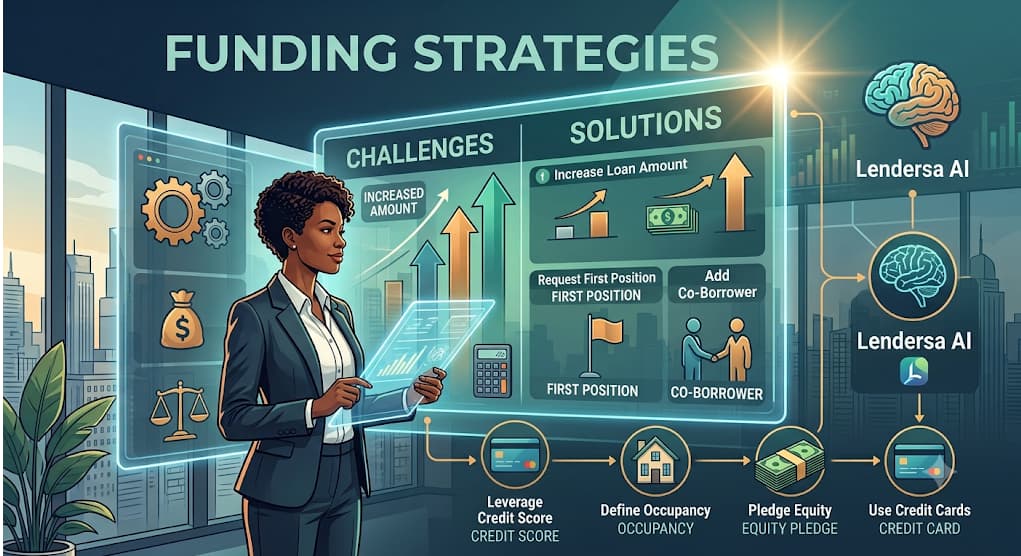
If you are struggling to secure financing under $100,000, Lendersa provides several actionable workarounds to get you approved.
1. Request a Larger Loan Amount
If your property has substantial equity, increasing your loan request is often the fastest solution. Lenders are significantly more responsive to higher loan amounts, as shown by Lendersa’s internal lender match rates:
| Loan Request Amount | Lendersa Match Rate | Expected Terms |
|---|---|---|
| $40,000 – $99,000 | 0% – 5% of lenders | Higher points, higher interest rates |
| $100,000 – $250,000 | 15% – 25% of lenders | Better rates and better terms |
| $250,000 – $500,000 | 30% – 70% of lenders | More competitive rates and better terms |
| $500,000 – $5,000,000 | 60% – 90% of lenders | The best rates and terms (Strongest competition among lenders) |
| $5,000,000+ | 10% – 12% of lenders | Good rates and terms |
Pro Tip: Request a larger amount and use the extra funds for property improvements, reserves, or other investments.
2. Request a Larger First-Position Loan (Avoid Small Seconds)
Requesting a small second-position loan behind an existing purchase loan is usually a waste of time—most lenders will not even consider it. Instead, request a completely new first-position purchase loan.
You may qualify for a new first-position loan equal to 65%–90% of the property value (though traditional hard money lenders often limit LTV to 60%–75%). If you need a larger second-position loan (typically above $300,000), Lendersa has lenders that can arrange these for commercial purchases with substantial equity or cross-collateralization.
3. Add a Co-Borrower
Co-borrowers can often help you qualify for a larger loan amount. While this is always true for conventional bank loans, it is slightly less relevant for non-owner-occupied business loans (which are based more on property equity and your exit plan than your personal ability to pay). Still, a strong co-borrower improves your overall borrower profile.
4. Leverage a High Credit Score
While hard money loans traditionally focus on collateral rather than credit history, borrowers with high credit scores benefit immensely. A strong credit profile can help you secure a higher Loan-to-Value (LTV) limit, making it easier to qualify for the minimum loan thresholds required by lenders.
5. Position as a Non-Owner Occupied Business Loan
Occupancy matters. Most hard money lenders stay away from owner-occupied properties regardless of your credit score or LTV.
The key for an owner-occupied loan is the lender’s regulatory requirement to strictly verify your capacity to repay the loan. If you apply for an owner-occupied hard money loan without income verification, funding is virtually impossible. However, if the property is for investment purposes and the LTV is low, requesting the loan as a non-owner business loan makes approval highly likely.
6. Pledge Additional Equity for Vacant Land
Trying to get a vacant land loan under $100,000 is exceptionally difficult. Land lending depends heavily on land entitlements, borrower experience, credit score, and low LTVs. The best solution? Pledge additional equity in another piece of real estate you own to cross-collateralize the deal and request a larger total loan amount.
7. Consider Credit Cards for Needs Under $50k
If you truly only need $20,000 to $50,000 and your credit score is high, acquiring one or more business or personal credit cards is often a better solution than hunting for a micro real estate loan. Although credit card interest rates are higher than standard real estate rates, they will help you achieve a short-term financial goal without the steep origination fees and closing costs of a mortgage.
Frequently Asked Questions (FAQ)
How to get a small real estate loans if my bank says no?
If traditional banks decline your request for a small real estate loan due to size, your best option is to use an AI-driven matching platform like Lendersa. Lendersa can connect you with specialized niche lenders or community institutions that have lower minimum limits, or help you restructure your request to attract more competitive offers.
How to get small hard money loan for an investment property?
The secret to getting a small hard money loan is to increase the loan amount to at least $100,000 by either pulling additional cash out for renovations or cross-collateralizing with another property you own. Hard money lenders strongly prefer loan amounts between $250,000 and $5,000,000, so grouping your funding needs will give you the best rates and terms.
Why do lenders charge higher rates on small real estate loans?
Because the administrative and underwriting costs are the same for a $50,000 loan as they are for a $500,000 loan, lenders must charge higher points and interest rates on small loans to make the deal profitable.
Conclusion: Find Your Loan Options Quickly
Trying to figure out exactly what kind of loan you can get is impossible without defining all the moving parts: LTV, credit, income and expenses, your experience, property location, and other real estate collateral.
The only way to quickly find out if a small real estate loan is possible for your specific scenario is to let technology do the heavy lifting. Enter a loan request on Lendersa today, and let our AI quickly match you with the right lenders or alternative funding solutions.