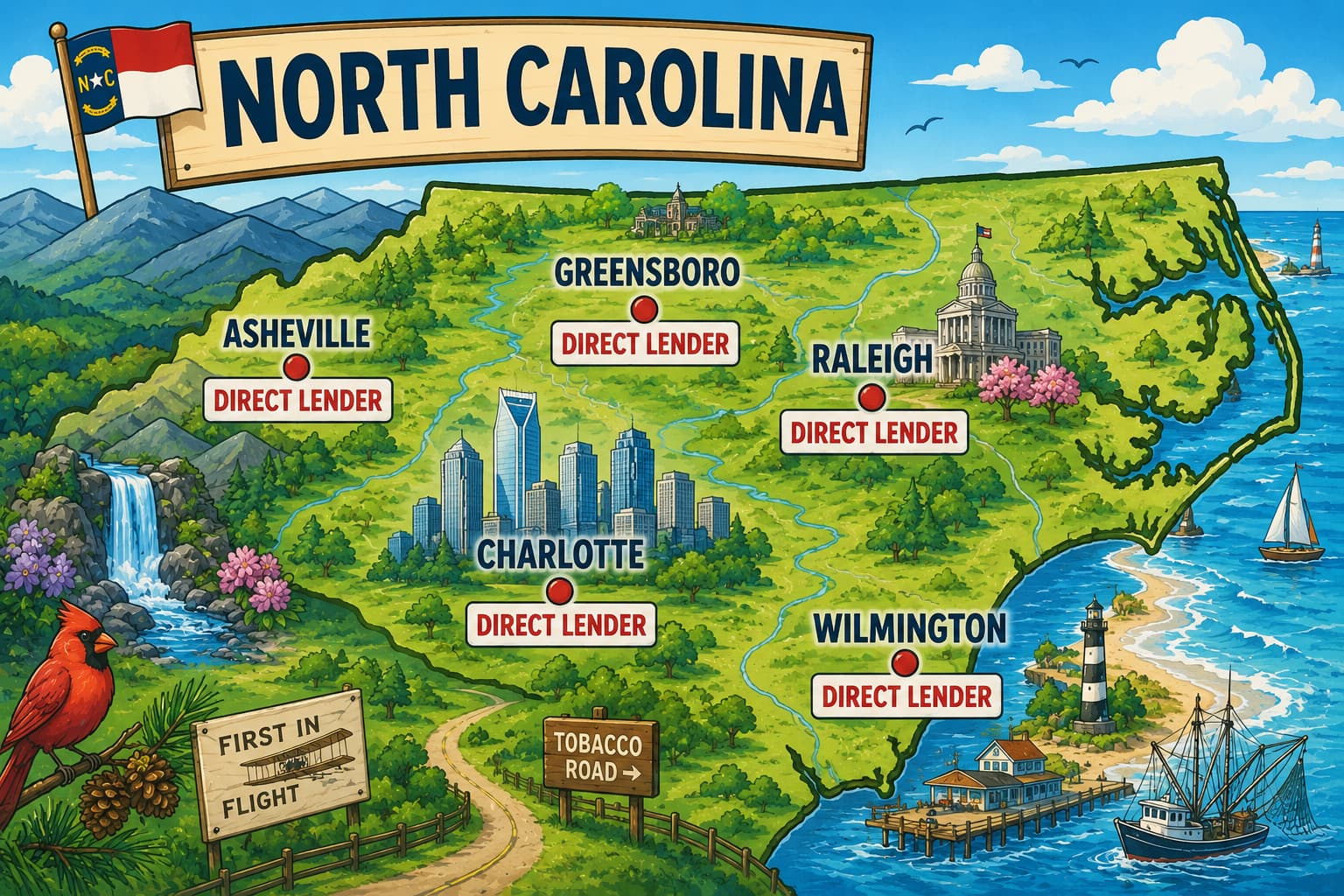
Whether you are looking to fix and flip a historic property in Charlotte, build new rental units in the Research Triangle, or reposition a commercial space in Asheville, securing fast, reliable capital is half the battle. In a fast-paced market like North Carolina, waiting on a traditional bank's sluggish 30-to-45-day underwriting process often means losing out on high-yield opportunities. That is where direct hard money lenders in North Carolina step in.
Unlike conventional mortgage institutions, direct hard money lenders provide asset-based financing. Instead of heavily scrutinizing your personal W-2s, tax returns, and debt-to-income (DTI) ratios, they evaluate your deal based on the property's After Repair Value (ARV), location, and project viability.
Here is your comprehensive, localized guide to navigating direct hard money loans in North Carolina, featuring cost breakdowns, a direct lender vs. traditional bank comparison, a curated directory of 11 top-rated lenders serving NC, and answers to your most critical financing questions.
👉 Ready to fund your next deal? Get Matched with Direct Hard Money Lenders in North Carolina Now
A direct lender uses their own balance sheet or private capital pool to fund your transaction. This eliminates middleman delays, allowing in-house underwriting teams to make immediate lending decisions.
Because North Carolina utilizes deeds of trust with power of sale (allowing non-judicial foreclosures), direct private lenders operate with reduced risk compared to judicial states. This legal framework enables active private lenders in the Tar Heel State to provide:
Hard money loans carry higher interest rates and origination points than conventional debt to offset short-term, asset-based risk. Understanding how hard money compares to traditional financing helps you accurately calculate project ROI:
Loan Feature | Direct Hard Money Lenders (NC) | Traditional Commercial Banks |
Typical Interest Rates | 10% – 13% (Interest-Only) | 6% – 8.5% (Amortized) |
Origination Points | 1% – 3% of Loan Amount | 0.5% – 1% |
Average Closing Time | 24 Hours – 10 Business Days | 30 – 60 Days |
Primary Qualifier | Property ARV & Equity Cushion | Borrower DTI, Tax Returns, & FICO |
Loan Terms | 6 to 24 Months (Short-Term) | 15 to 30 Years (Long-Term) |
For a typical $250,000 fix-and-flip acquisition in Raleigh or Greensboro with a 12% interest rate and 2 points origination fee:
👉 Stop chasing capital and make lenders compete for your scenario. Compare Real-Time North Carolina Hard Money Rates
When you need a direct lender that controls its capital and underwrites in-house, these 11 private lending sources actively fund non-owner-occupied transactions across North Carolina:
Active Metros: Statewide (Charlotte, Raleigh, Greensboro, Coast)
Loan Types: Fix & Flip, Ground-Up Construction, Multifamily, DSCR
Best For: Institutional scale and multi-property portfolio deployment.
Overview: Although a large national lender headquartered nearby, Lima One has deep, localized experience in North Carolina. Founded by Marines, they provide institutional-grade loan products, making them highly reliable for seasoned investors needing capital scale.
A direct hard money lender finances your deal using their own internal balance sheet or fund, meaning all underwriting, risk assessment, and approval decisions happen in-house. This eliminates brokers and intermediaries, accelerating your closing timeline.
Most direct hard money lenders in North Carolina do not enforce strict minimum credit score requirements. Because the loan is secured by property equity, a lower credit score typically adjusts your terms (e.g., requiring 5% to 10% more cash down) rather than causing an outright denial. Most institutional hard money programs look for a baseline FICO score around 600 to 640.
Speed is the primary advantage of hard money. While traditional bank financing takes 30 to 45 days, direct hard money lenders in North Carolina typically fund deals in 7 to 10 business days. Specialized lenders can execute clean, straightforward transactions in 24 to 48 hours.
While buyers usually need some "skin in the game" for the purchase price (with lenders funding 85% to 90% of acquisition costs), many North Carolina lenders will fund 100% of your construction/rehabilitation expenses—provided the total combined loan remains under 70% to 75% of the After Repair Value (ARV).
Yes. To comply with consumer protection regulations, hard money loans in North Carolina are classified as commercial, business-purpose loans. Borrowers must close under an LLC, Corporation, or Partnership, and the property must be non-owner-occupied.
Instead of calling lenders individually to compare underwriting criteria, leverage AI-driven loan matching to source competitive terms for your exact deal parameters.
👉 Submit Your North Carolina Loan Scenario Today



