USDA Vs. FHA Pro and Con comparison in Weaverville, Buncombe County, NC
For the year 2026, in the city of Weaverville, located in the county of Buncombe, NC, the USDA loan limit is set at $336,500. Conversely, the limit for an FHA loan catering to single-family homes is $472,030.
Make use of the Lendersa® USDA loan calculator to examine and compare today’s top USDA and FHA rates. Assess the required income, credit score, reserves, and necessary documents to see what is needed for qualification. Our sophisticated mortgage calculator also shows you USDA, FHA, Conforming, and VA options side by side, helping you to choose the best program in that suits your financial standing.
2026 Loan Limits and Down Payment Requirements in Weaverville, Buncombe, NC
Loan Category
Loan Limit
Minimum Down Payment
USDA
$336,500
0%
FHA
$472,030
3.5%
Conventional Conforming
$726,200
3%
Exploring USDA and FHA Loan Options in Weaverville, NC
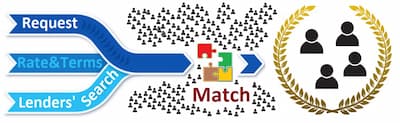
The mission of Lendersa® is to assist you in securing the optimal USDA or FHA loan swiftly and effortlessly. You can begin with any one of three options which link you to lenders and USDA loan programs.
A USDA home loan is a mortgage backed by the U.S. Department of Agriculture, also known as a USDA rural development loan or USDA mortgage. These loans are available only in rural areas. Unlike FHA mortgages, which demand a minimum down payment of 3.5%, the USDA loan eliminates down payment requirements altogether.
151 Patton Avenue, Suite 280, Asheville, NC, 28801
Lends in North Carolina
Arcade Credit Union is a non-profit financial cooperative that is owned by its members. We were chartered in 1952 and serve the employees and retirees of the Federal Building and the Federal Courthouse Building. We also serve multiple companies. All members’ immediate families are also eligible for membership.
ALFIE is a real estate collateral-based lender specializing in creative solutions for individuals looking to purchase or refinance a variety of real estate investments. At ALFIE, we recognize that traditional financing isn't always an option or may not be the right fit for your needs.
HomeTrust is a regional community bank, focused on the areas we serve by providing better financial services and community support. We have more than 40 banking locations across North Carolina, Upstate South Carolina, East Tennessee and Southwest Virginia, as well as banking through online and mobile channels.
PlumDog, we believe the most important decision a client makes is choosing the right mortgage company to assure the best possible results for their investment. When dealing with your largest asset and greatest liability, one quickly understands the need for personalized lending assistance.
At Lucid Lending we look forward to matching you with the best mortgage program to fit your needs. We know everyone has a different situation, some are more unique that others, and it is important that you work with someone that has the knowledge and experience of the constantly changing mortgage industry.
USFScorp Commercial Bridge Loans. Bridge Loans for Commercial, Business, Short Term Real Estate Bridge Loans, Construction Bridge Loans, Bad Credit Bridge Loans. Contact Us Today for Info Or To Apply For Bridge Loans US
A commercial bridge loan can provide many benefits such as providing the flexibility to take advantage of opportunities right
Telco Community Credit Union has been providing financial services to communities in the Western North Carolina Area for over 80 years. We were organized in 1935 to serve the employees of the Southern Bell Telephone System. Today, we are a community chartered credit union serving in 21 counties.
We specialize in USDA Loans in Buncombe, Henderson, Madison, Transylvania, Haywood McDowell, Polk and Rutherfordton County. We also serve the cities surrounding Asheville such as Hendersonville, Weaverville, Marshall, Brevard, Candler, Waynesville, Etowah, Mills River, Burnsville, Spruce Pine, Black Mountain, Swannanoa, and Old Fort.
MortgageMatchMakers.com, we understand that for most people, a home is the single biggest purchase you will ever make. Yet most people shop around more for a pair of shoes! As an independent mortgage banker, we do the shopping for you. Our goal is to match you with the perfect mortgage.