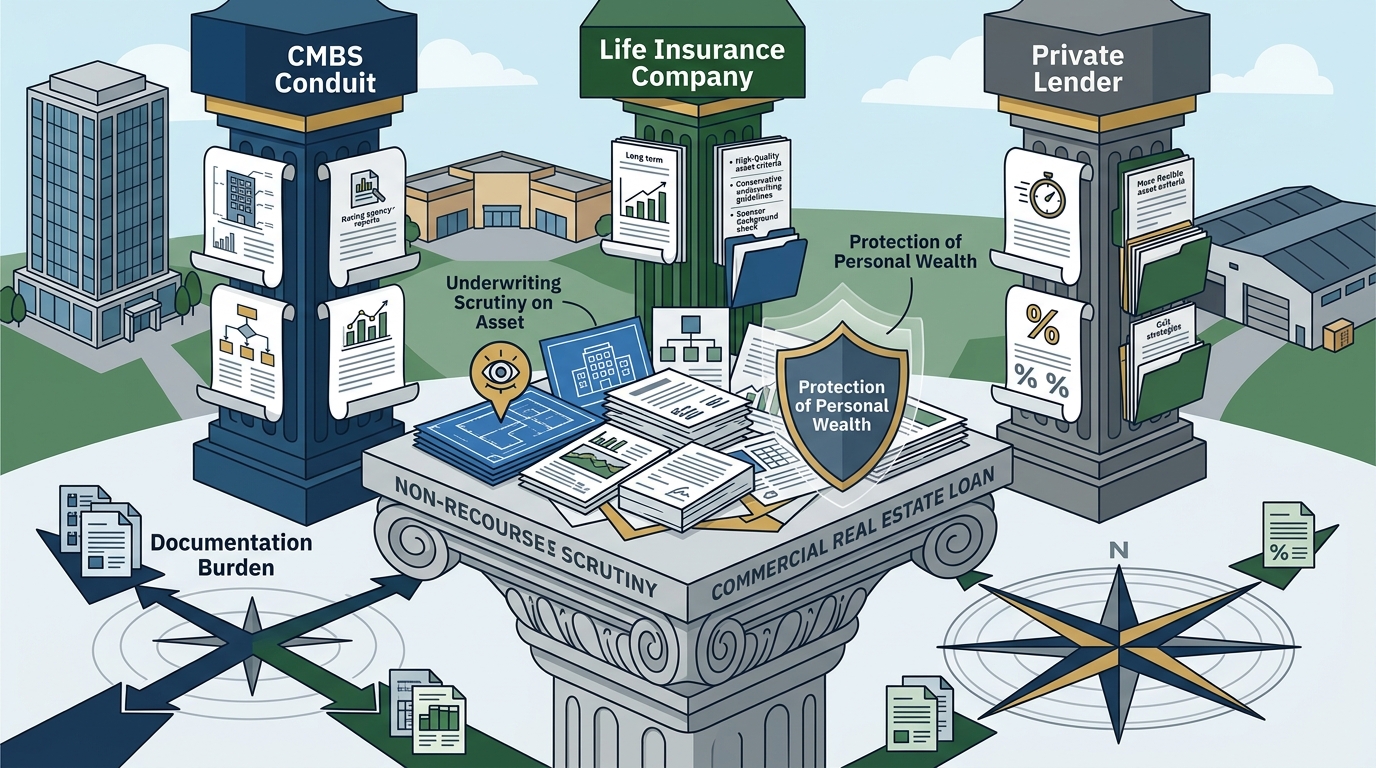
Non-Recourse CRE Loan Documents Explained: What CMBS, Life Company, and Private Lenders Each Expect
Non-recourse commercial real estate loans protect your
personal wealth—but the trade-off is a documentation burden that varies
dramatically depending on which lender channel you choose. This
comparison breaks down exactly what CMBS conduits, life insurance
companies, and private lenders require so you can prepare the right
package the first time.
Why Documentation Requirements Differ by Lender Type
In
a non-recourse structure, the lender's only recovery upon default is
the collateral property itself. Because the lender absorbs more risk,
underwriting scrutiny shifts almost entirely to the asset and the
borrowing entity. However, the depth and format of that scrutiny depend
on who is making the loan.
CMBS conduits securitize loans into
bonds sold to investors, so their documentation must satisfy rating
agencies and federal regulations. Life insurance companies hold loans on
their balance sheets and emphasize long-term cash-flow stability.
Private and hard money lenders move faster but may require different
collateral proof. Understanding these distinctions lets you assemble the
correct file from day one instead of scrambling mid-underwriting.
Five Documents Every Non-Recourse Lender Requires
Regardless of the lending channel, you should expect to produce these five core items:
Personal Financial Statement (PFS)
— Even though the loan is non-recourse, lenders still underwrite the
sponsor. A PFS shows liquid assets, net worth, and existing liabilities.
CMBS lenders typically use a standardized template.
Schedule of Real Estate Owned (SREO)
— This lists every property you own or have an interest in, along with
each property's NOI and outstanding debt. It demonstrates your track
record and overall exposure.
Rent Roll — A
current rent roll shows every tenant, lease term, monthly rent, and any
concessions. It is the starting point for underwriting property income.
Operating Statements (Trailing 3 Years)
— Year-end income and expense statements prove the property's
historical performance. Lenders use these to calculate a stabilized NOI.
Entity Organizational Documents — Articles of Organization, Operating Agreement, and Certificate of Good Standing for the borrowing entity are always required.
CMBS Conduit Loan Documents
CMBS
loans are the most documentation-intensive non-recourse product.
Because the loan will be pooled and sold to bond investors, every piece
of paper must survive rating-agency review.
Borrower and Sponsor Package
PFS and SREO for every principal with 20% or more ownership
Résumé or bio for each key principal, emphasizing CRE experience
Three years of personal and business tax returns
Authorization for background and credit checks on all principals
Organizational chart showing the full ownership structure from top-level individuals down to the borrowing SPE
Property Financial Package
Trailing 12-month operating statement broken out by month
Three years of year-end operating statements
Current rent roll with lease expiration schedule
Copies of all executed tenant leases (or a sample lease for multifamily)
Representations and warranties mirroring lender reps for securitization
Defeasance or yield-maintenance schedule acknowledgment
Expect
60 to 90 days from application to closing for a CMBS deal. Hiring an
attorney experienced in CMBS closings is critical; inexperienced counsel
can add thousands in legal fees by challenging non-negotiable
securitization provisions.
Life Insurance Company Loan Documents
Life
companies (also called “life cos”) hold loans in their general
accounts, so they focus on long-term stability rather than
securitization compliance. Documentation is still thorough but slightly
less rigid in format.
What Life Companies Emphasize Differently
Audited financials preferred
— While CMBS lenders accept borrower-prepared statements with a CPA
review letter, many life companies want full audited statements for both
the property and the sponsor entity.
Detailed market study
— Life companies often request a custom market analysis beyond the
standard appraisal, covering submarket vacancy trends, competitive
supply pipeline, and demographic data.
Insurance portfolio alignment memo
— Some life companies require an internal memo showing how the asset
fits their portfolio allocation. While you do not produce this document,
you may need to supply supplementary data (e.g., tenant credit ratings,
weighted-average lease term) to support it.
Property management agreement
— If a third-party manager operates the asset, life companies typically
want the full management contract and manager financials.
Documents Shared With CMBS
PFS,
SREO, rent roll, operating statements, organizational documents, and
third-party reports (appraisal, Phase I environmental, property
condition report) are still required—just submitted in the life
company's preferred format rather than the CMBS standardized templates.
Private and Hard Money Non-Recourse Documents
Private
lenders and hard money shops offer non-recourse terms on select
deals—typically stabilized assets with conservative LTV ratios. Their
documentation requirements are leaner but still meaningful.
Typical Private Lender Package
Loan application or deal summary (1–2 pages)
PFS and SREO for the sponsor
Rent roll and trailing 12-month operating statement
Purchase contract or payoff statement (for acquisitions or refinances)
Photos of the property (exterior and interior)
Proof of hazard and liability insurance
Entity documents (Articles of Organization, Operating Agreement)
What Private Lenders Skip
Private
lenders usually do not require borrower opinion letters, formal cash
management structures, or the multi-layered SPE covenants that CMBS
lenders demand. However, they may require a personal guarantee on “bad
boy” carve-outs—meaning fraud, misrepresentation, or environmental
contamination can still trigger personal liability even in a
non-recourse deal.
Private non-recourse bridge loans add one more
requirement: a detailed exit strategy showing exactly how you will repay
the loan, either through sale or refinance into permanent debt.
SPE Formation Papers: The Non-Recourse Cornerstone
Nearly
every non-recourse commercial loan requires the borrowing entity to be a
Single Purpose Entity. The SPE exists solely to hold and operate the
collateral property, isolating it from the sponsor's other assets and
liabilities.
SPE Documentation Includes
Articles of Organization / Certificate of Formation — Filed with the state, creating the LLC or LP.
Operating Agreement with SPE Covenants
— Contains bankruptcy-remoteness provisions, including the requirement
for an independent director or manager whose consent is needed before
filing for bankruptcy.
Certificate of Good Standing — Proves the entity is current with state filings.
EIN Confirmation Letter — IRS-issued employer identification number for the entity.
Organizational Chart — Visual depiction showing every level of ownership from the SPE up to natural persons.
CMBS
lenders are the strictest about SPE compliance. Violations of SPE
covenants can convert the entire loan to full recourse under bad-boy
carve-out provisions.
Third-Party Reports Across All Channels
Non-recourse
lenders order (and borrowers pay for) independent reports to verify the
asset's value and condition. These reports are required regardless of
lender type, though scope may vary.
Report
CMBS
Life Company
Private
MAI Appraisal
Always required
Always required
Usually required; some accept BPO for smaller deals
Phase I Environmental Site Assessment
Always required
Always required
Required for most deals over $1M
Property Condition Report (PCR)
Always required
Always required
Often required; sometimes waived for newer assets
Seismic Risk Assessment
Required in seismic zones
Required in seismic zones
Rarely required
Zoning Report / Compliance Letter
Always required
Usually required
Sometimes required
ALTA Survey
Always required
Always required
Required for acquisitions; sometimes waived for refis
Closing-Table Documents Unique to Non-Recourse Deals
At closing, non-recourse loans generate several documents that recourse deals do not:
Non-Recourse Carve-Out Guaranty
— The guarantor (usually the sponsor or a principal) signs a limited
guaranty covering only the “bad boy” acts such as fraud,
misrepresentation, misapplication of rents, failure to maintain
insurance, and voluntary bankruptcy filing.
Environmental Indemnity Agreement
— Separate from the Phase I report, this agreement assigns personal
liability for environmental contamination regardless of the loan's
non-recourse status.
Assignment of Leases and Rents — Gives the lender the right to collect rents directly if the borrower defaults.
Lockbox / Cash Management Agreement — Required by CMBS lenders and many life companies; directs tenant payments into a lender-controlled account.
Subordination, Non-Disturbance, and Attornment Agreements (SNDAs) — Executed by major tenants, confirming their leases survive foreclosure.
Borrower's Counsel Opinion Letters — Legal opinions on enforceability, due authorization, SPE status, and (for CMBS) non-consolidation.
Common Documentation Mistakes That Kill Deals
Submitting a stale PFS.
Most lenders require a PFS dated within 60 to 90 days of application.
An outdated statement triggers a re-request and delays underwriting.
Incomplete organizational charts.
If the ownership structure involves joint ventures, trusts, or
mezzanine equity, every layer must be disclosed. CMBS lenders will not
proceed without a complete org chart.
Missing lease abstracts for commercial tenants.
Multifamily deals can submit a sample lease, but office, retail, and
industrial properties need individual lease copies or certified
abstracts for every tenant.
Ignoring bad-boy carve-outs.
Borrowers sometimes fixate on the “non-recourse” label and overlook the
carve-out guaranty. Fraud, misrepresentation, or environmental issues
can still expose personal assets.
Hiring inexperienced legal counsel.
CMBS loan documents are lengthy and contain non-negotiable provisions
mandated by securitization rules. An attorney unfamiliar with CMBS
closings can rack up unnecessary legal fees and delay closing.
How Lendersa Simplifies the Process
Assembling the right document package depends on knowing which lender channel fits your deal. Lendersa
is an AI-powered loan marketplace that matches your commercial property
with competing lenders—CMBS conduits, life companies, banks, and
private capital sources—so you can compare non-recourse offers side by
side.
No SSN required to start. Submit your deal parameters and get matched with lenders before sharing sensitive personal data.
Multi-channel comparison. See how documentation requirements, rates, and terms differ across lender types for the same property.
Streamlined uploads.
Once you choose a lender, Lendersa's platform guides you through the
exact documents that specific lender needs—eliminating guesswork and
reducing back-and-forth.
Whether your property is residential, commercial, or vacant land, Lendersa connects you with lenders who compete for your deal.
Key Takeaways
Non-recourse
loans shift lender risk to the property, so documentation focuses
heavily on asset performance, entity structure, and third-party
verification.
CMBS conduits have the most rigid requirements because loans are securitized and must satisfy rating agencies.
Life insurance companies emphasize audited financials and long-term market stability over securitization compliance.
Private
lenders accept leaner packages but still require SPE formation, rent
rolls, operating statements, and a clear exit strategy for bridge deals.
Every
non-recourse deal requires SPE organizational documents, a non-recourse
carve-out guaranty, and an environmental indemnity—regardless of lender
type.
Use a marketplace like Lendersa to compare lender requirements and offers before committing to a single channel.
Frequently Asked Questions
Do I still need to provide personal financial information for a non-recourse loan?
Yes.
Even though you are not personally guaranteeing the full loan, lenders
still underwrite the sponsor. You will need a Personal Financial
Statement and Schedule of Real Estate Owned to demonstrate financial
strength and CRE experience. Non-recourse lenders are generally only
available to borrowers with a very strong financial profile.
What is a Single Purpose Entity and why is it required?
A
Single Purpose Entity (SPE) is an LLC or LP created solely to hold the
collateral property. It isolates the asset from the sponsor's other
business activities and includes bankruptcy-remoteness provisions—such
as requiring an independent director's consent before filing for
bankruptcy—to protect the lender.
How long does it take to close a non-recourse commercial real estate loan?
Timelines
vary by lender type. CMBS loans typically take 60 to 90 days from
application to closing. Life company loans follow a similar timeline.
Private lenders can sometimes close in 30 to 45 days for straightforward
deals, though complex assets may take longer.
What are bad-boy carve-outs in a non-recourse loan?
Bad-boy
carve-outs are exceptions written into non-recourse loan documents that
can trigger personal liability. Common triggers include fraud, material
misrepresentation, misappropriation of rents or insurance proceeds,
failure to maintain required insurance, and voluntary bankruptcy filing.
If any of these occur, the lender can pursue the sponsor's personal
assets.
Can I get a non-recourse loan for a property that is not yet stabilized?
Standard
non-recourse permanent loans require stabilized, income-producing
properties. For transitional or value-add assets, non-recourse bridge
loans are available from select private lenders. These short-term loans
(typically 12 to 36 months) require a detailed exit strategy and may
carry higher interest rates.
Does Lendersa help with non-recourse commercial loan applications?
Yes. Lendersa
is an AI-powered loan marketplace that connects borrowers with CMBS
conduits, life companies, banks, and private lenders. You can compare
non-recourse offers for residential, commercial, and vacant land
properties—no SSN required to start.