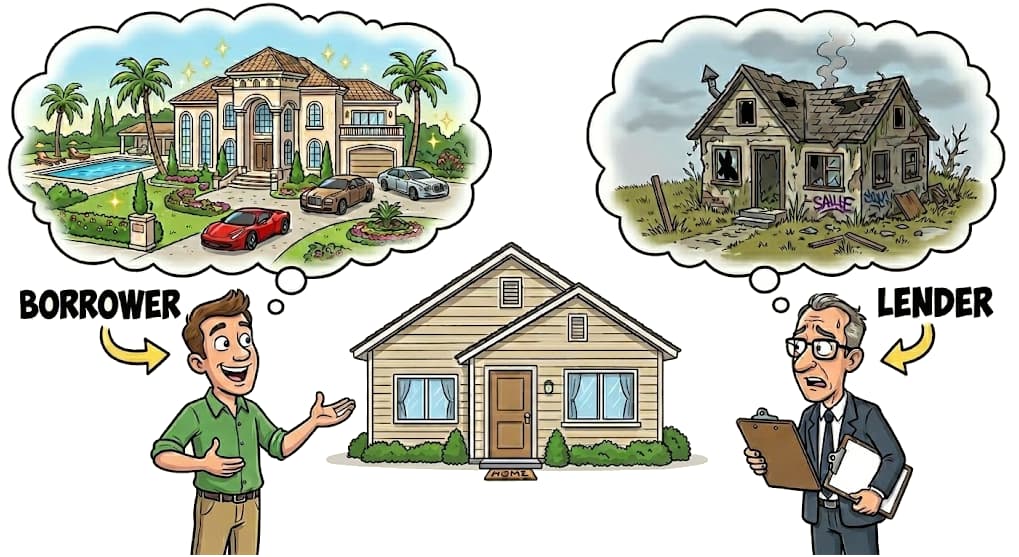
Understanding Hard Money Loan-to-Value (LTV) and property valuation is the single most critical factor in securing private real estate funding. While traditional banks focus heavily on borrower credit and income, hard money lenders prioritize the physical asset.
For real estate investors, miscalculating a property's objective value does not just result in a lower appraisal—it directly impacts your maximum hard money LTV, shrinking the amount of capital you receive and reducing the number of private lenders willing to fund your deal.
Here is the comprehensive breakdown of how property valuation, hard money loan-to-value limits, and credit scores intersect in the private lending industry.
How Hard Money Lenders Manage Risk: Asset vs. Income
To understand the strict valuation requirements of private money, one must look at how risk is calculated differently from conventional banking.
Conventional Lenders: Banks base loan approvals primarily on a borrower's ability to repay. They analyze W-2s, tax returns, debt-to-income ratios, and credit histories. The property serves as collateral, but the borrower's financial profile is the primary security.
Hard Money Lenders: Private lenders operate on the assumption that traditional income verification is unavailable or insufficient. Therefore, they rely on the property's equity as their sole security for the loan.
If a borrower defaults, the hard money lender's only recourse to recoup their capital is to foreclose on the property. Because of this liquidation risk, the asset's real-world value and the approved Hard Money LTV are the most critical metrics in private lending.
How Property Valuation Directly Affects Hard Money Loan Amounts
The ultimate reason a hard money loan is declined or reduced is insufficient equity in the property. Hard money lenders cap their risk using a maximum Loan-to-Value (LTV) percentage. However, because different lenders interpret property value differently, a higher LTV percentage does not mathematically guarantee a larger loan.
Consider this mathematical breakdown of how raw property valuation alters total funding:
Lender A approves a maximum 70% LTV, but values the property conservatively at $700,000. The maximum loan amount is $490,000.
Lender B approves a tighter 65% LTV, but values the property at $800,000. The maximum loan amount is $520,000.
Even though Lender B offered a lower LTV cap, the borrower nets $30,000 more in funding simply because Lender B’s opinion of the property value was higher.
Property value in real estate is subjective. Borrowers must manage three distinct opinions: the investor supplying the capital, the broker facilitating the deal, and the licensed appraiser evaluating the asset. Because opinions vary, shopping a loan scenario across multiple lenders is essential to finding the valuation that meets the capital requirement.
The Hard Money LTV & Credit Score Matrix
A borrower's target LTV drastically changes the underwriting landscape. The data matrix below illustrates how a desired Hard Money LTV correlates with minimum credit score requirements and how it impacts the total pool of private lenders available to fund a residential transaction.
| Target LTV | Minimum Credit Score Required | Potential Hard Money Lenders Available |
| 50% | 400 | 1,000 Lenders |
| 60% | 500 | 800 Lenders |
| 65% | 500 - 650 | 350 Lenders |
| 70% | 640 - 700 | 200 Lenders |
| 75% | 680 - 720 | 150 Lenders |
| 80% | 740 | 23 Lenders |
| 90% | 760 | 12 Lenders |
| 100% | 780 | 5 Lenders |
Analyzing the Data: Up to a 65% LTV, a borrower's credit score does not heavily restrict the LTV limit. While clean credit secures better interest rates and terms, a massive 35% equity cushion opens the door to hundreds of private lenders, even for borrowers with low credit score hard money LTV requirements. However, once the LTV exceeds 75%, the lender pool aggressively shrinks. High-LTV loans require near-perfect credit to offset the extreme risk to the lender's capital.
Note: This matrix applies generally to residential property loans in the first lien position. Individual loan scenarios are influenced by secondary factors including investor experience, property location, property type, loan purpose, exit strategy, and liquid assets.
🚀 Residential Loan Action: Do not settle for a single lender's LTV cap. Submit your residential loan request to see your options, or start your loan scenario now to get your deal in front of hundreds of verified hard money lenders in minutes.
Valuation Differences by Property Type
A lender's method for verifying value and establishing a commercial hard money LTV depends entirely on the asset class.
1. Tract Homes (Standard Residential)
For a standard home in a typical subdivision, verifying value is straightforward. Lenders can rely on recent, identical comparable sales ("comps") in the immediate neighborhood to quickly validate the estimated value.
2. Custom Homes and Commercial Properties
Commercial properties and unique custom homes lack direct comparable sales. Value must be established by a specialized commercial appraiser. Commercial underwriting utilizes entirely different metrics and typically demands lower LTV limits to protect against market illiquidity.
🏢 Commercial Real Estate Action: Commercial assets require customized capital solutions. Find commercial hard money lenders for your next project and secure multiple competitive term sheets.
3. Vacant Land
Vacant land is considered the highest-risk asset class in hard money lending because it generates no income and can be difficult to liquidate. LTVs for land are exceptionally conservative, often capping at 40% to 50%.
🌳 Vacant Land Action: Funding land requires highly specialized investors. Request a vacant land loan quote today to connect with lenders actively funding raw and entitled land.
Pro Tip: Using AI to Stress-Test Property Value
Before submitting a loan request, real estate investors can utilize advanced AI search engines (like Perplexity) to establish a grounded, conservative property valuation baseline.
Step 1: Establish the Baseline
Prompt the AI with: "I am considering a hard money loan on a property at [Insert Address]. What is a conservative valuation for that property based on current data?"
Step 2: Refine the Data
Public records frequently lag behind real-world conditions. Prompt the AI to adjust for legally permitted upgrades: "The public data is outdated. Please recalculate a conservative valuation considering these verified updates: The property now has [X] square feet, [X] bedrooms, and [X] bathrooms, plus a newly permitted [addition/kitchen/pool]."
How Unpermitted Structures Affect Hard Money Loans
Unpermitted additions—such as a garage conversion or guest house—create a valuation wildcard. Traditional appraisers and conservative hard money lenders will assign zero value to unpermitted square footage. In some instances, it may reduce the value if the lender factors in the cost of municipal fines or demolition.
However, private money is flexible. Creative private lenders may view high-quality, unpermitted construction as an asset. These lenders will often structure the loan to hold back specific escrow funds designed to bring the unpermitted structure up to code. Once permitted, the property achieves a higher, verifiable After Repair Value (ARV), benefiting both the borrower's equity and the lender's security.
Frequently Asked Questions: Hard Money LTV & Appraisals
What is the difference between Fair Market Value (FMV) and Liquidation Value?
Fair Market Value represents the highest price a willing buyer pays under normal, unhurried market conditions. Hard money lenders utilize Liquidation Value (or "Quick Sale Value"). This is the heavily discounted price the property would sell for within a 30-to-90-day window if the lender had to foreclose and sell the asset immediately.
What are ARV and LTV, and how do they determine loan amounts?
ARV (After Repair Value) is the estimated market value of a property once all proposed renovations are completed. LTV (Loan-to-Value) is the maximum percentage of that value the lender will finance. For example, if a lender offers a 70% LTV on a property with a $300,000 ARV, the mathematical maximum loan amount is $210,000.
Why is a hard money appraisal lower than an online real estate estimate?
Online algorithms (like Zestimates) aggregate retail data, assuming the property is in peak condition and will sit on the open market indefinitely to attract a premium buyer. Hard money appraisers evaluate immediate liquidation risk, discounting heavily for deferred maintenance to establish a protective financial floor.
How long does a hard money valuation process take?
Hard money valuations are designed for speed. A standard appraisal is typically completed within 3 to 7 business days. If the requested LTV is exceptionally low, lenders may utilize an internal "desktop valuation" or drive-by evaluation, completing the process in 24 to 48 hours.
Do hard money lenders always require a full interior appraisal?
No. If the target LTV is very low and the property is a standard tract home with abundant comparable sales, lenders may waive the formal interior appraisal. Instead, they will rely on data models and exterior/interior photographs provided by the borrower to verify the baseline condition.
Can a borrower use an appraisal previously paid for from a different lender?
Generally, no. Hard money lenders require an independent valuation ordered directly through their own approved network of appraisers. This ensures the valuation is unbiased, prevents conflicts of interest, and guarantees the numbers have not been artificially inflated by the borrower.
What happens if the hard money appraisal comes in lower than the purchase price?
Hard money lenders calculate their maximum LTV based on the lesser of the purchase price or the appraised value. If a property is under contract for $200,000 but appraises at $180,000, the lender will base the loan on the $180,000 value, requiring the borrower to cover the shortfall with additional cash at closing.



