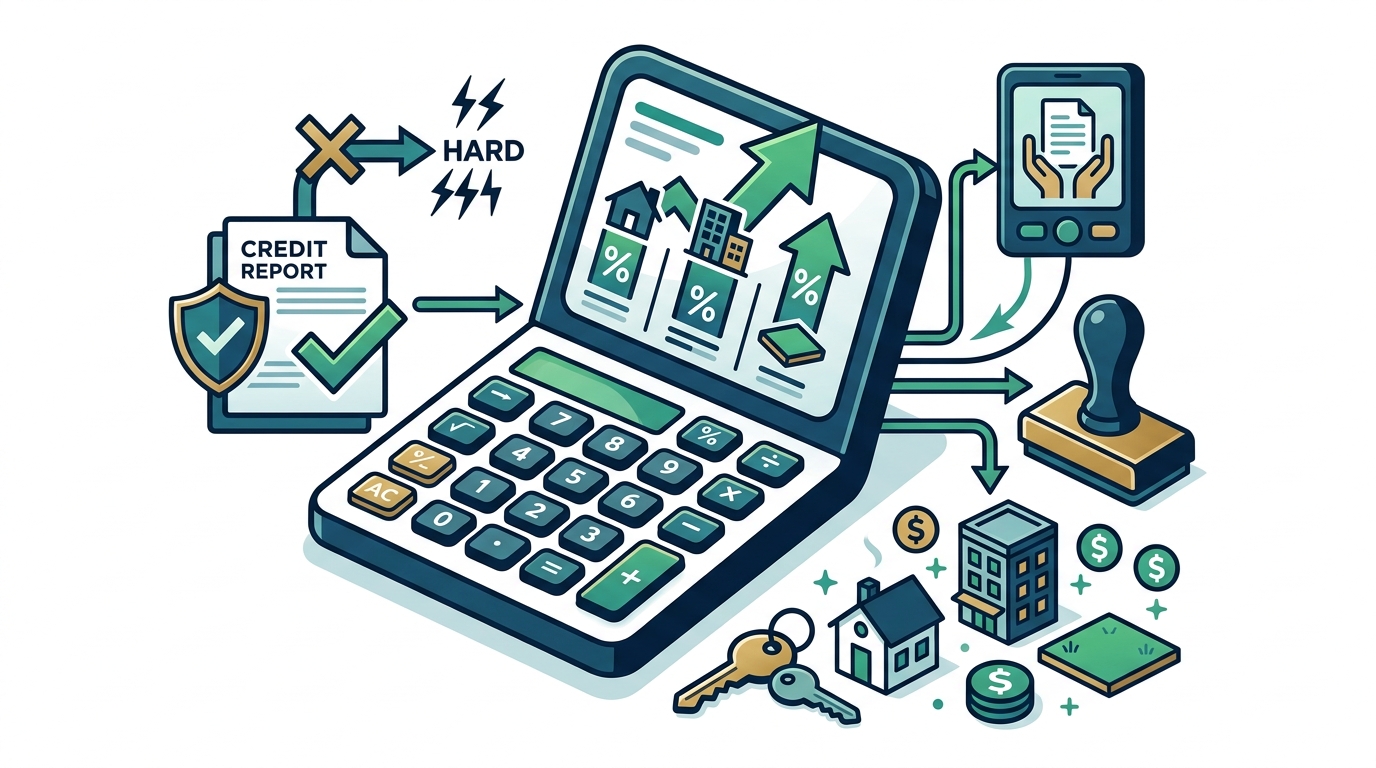
Shop Hard Money Lenders Without Hurting Your Credit Score
Shopping for a hard money loan used to mean handing over your Social
Security number to every lender on your list and watching hard inquiries
pile up on your credit report. Today, borrowers can compare rates,
terms, and lender programs without triggering a single hard credit pull.
A soft inquiry is a credit check that does not affect your credit
score, and many hard money platforms now rely on soft inquiries or no
credit check at all during the initial comparison phase. Below, you will
learn exactly how to evaluate hard money loan offers while keeping your
credit intact, which tools make it possible, and why asset-based
lending is uniquely suited to this approach.
What Is a Hard Money Loan?
A
hard money loan is a short-term, asset-based loan secured by real
estate and funded by private investors or portfolio lenders rather than
traditional banks. Approval hinges primarily on the ratio between the
loan amount and the property's market value, not the borrower's income
or credit history. These loans are also known as asset-based loans,
equity loans, or bridge loans.
Hard money loan programs generally
fall into three categories: Hard-Hard Money (HH), Soft-Hard Money (SH),
and Non-QM (NQ). While HH lenders focus exclusively on property equity,
SH and NQ lenders may factor in credit and repayment ability to offer
higher loan-to-value ratios and better terms. You can explore each
category in depth on the Lendersa hard money loan definition page.
Hard Pull vs. Soft Pull: Why It Matters
A hard credit pull occurs when a lender reviews your full credit report as part of a formal lending decision. According to myFICO,
hard inquiries can lower your credit score and remain on your report
for up to two years. A soft credit pull, by contrast, is a review of
your credit that does not affect your score at all.
The National Foundation for Credit Counseling
notes that most hard inquiries cost fewer than five points, but
multiple pulls in a short window can compound. For real estate investors
comparing several lenders at once, those points add up fast. That is
why finding platforms that use soft inquiries or no credit check during
the comparison stage is so valuable.
Why Hard Money Lenders Can Skip the Credit Pull
Hard
money loans are asset-based, meaning lenders primarily consider the
value of the property being used as collateral rather than the
borrower's credit score. Many hard money lenders still lend based only
on a low loan-to-value ratio of 55% to 65%, regardless of credit or
income, provided the property is non-owner occupied or the loan is for a
business purpose.
Because the collateral drives the underwriting
decision, initial rate quotes and prequalification can happen without a
credit inquiry. Platforms like Lendersa's hard money loan calculator
let you enter your property type, zip code, and loan amount to see
matching programs from thousands of lenders instantly, with no SSN
required.
Step-by-Step: Compare Rates Without a Credit Pull
Step 1: Use an AI-Powered Loan Calculator
Start with a calculator that pulls real-time rate data. The Lendersa Advanced Calculator
uses over 15 separate factors, including property type, LTV, location,
and vesting, to match your scenario against millions of loan programs.
No confidential financial information is needed at this stage.
Step 2: Review Your LoanScore
LoanScore
is a proprietary metric that indicates how well your loan request
matches available programs. A high LoanScore means multiple lenders will
compete for your deal. If your score is low, use the LoanImprove tool
to adjust variables like loan amount or property type before submitting
to lenders. Learn more about improving your request on the Lendersa hard money loans page.
Step 3: Submit a Loan Request (Not an Application)
A
loan request is not a loan application. Your Social Security number and
other confidential details are not required. When you submit through a
marketplace like Lendersa, AI matches your request with the best-fitting
lenders who then compete to offer you terms. You can browse the full hard money lenders directory covering over 4,500 lenders in all 50 states.
Key Factors That Influence Hard Money Rates
Understanding
what drives your rate helps you negotiate better terms, even before a
lender pulls credit. The main factors include:
Loan-to-Value (LTV) Ratio: Lower LTV means less risk for the lender and typically a lower rate. Most hard money lenders cap LTV at 60% to 75%.
Property Location and Condition: Properties in desirable areas or good condition qualify for better pricing.
Borrower Experience: Investors with a track record of successful projects often secure lower rates.
Loan Term and Exit Strategy: Short holds with a clear exit, such as a sale or refinance, reduce lender risk.
Market Conditions: In competitive lending markets rates trend lower; in uncertain economies they rise.
Current first-position hard money rates generally range from 9% to 15%, with origination fees of 1 to 5 points. Comparing your all-in cost, not just the headline rate, is essential.
Hard Money vs. Conventional: A Side-by-Side Comparison
Feature
Hard Money Loan
Conventional Loan
Approval Basis
Property value / equity
Credit score, income, DTI
Credit Pull at Comparison Stage
Often none or soft pull
Typically hard pull
Interest Rate Range
9% - 15%
6% - 8%
Typical LTV
55% - 75%
80% - 97%
Time to Close
5 - 15 business days
30 - 60 days
Loan Term
6 - 36 months
15 - 30 years
SSN Required to Compare
No (on platforms like Lendersa)
Yes, for most prequalifications
Key Takeaways
Hard money loans are asset-based, so lenders can quote rates based on property equity without pulling your credit.
A
soft credit pull does not affect your credit score; a hard pull can
cost up to five points and stays on your report for two years.
AI-powered calculators like the one on Lendersa let you compare thousands of loan programs in seconds with no SSN required.
Your LTV ratio, property condition, and borrower experience are the biggest drivers of hard money rates.
Current first-position hard money rates typically fall between 9% and 15%, plus origination points.
Submitting a loan request is different from a loan application: no confidential information is needed.
Always calculate the total cost of capital, including points and fees, not just the interest rate.
Frequently Asked Questions
Can I really compare hard money loan rates without giving my SSN?
Yes.
Platforms like Lendersa allow you to enter property details, loan
amount, and location to receive rate estimates from thousands of
lenders. Because hard money underwriting focuses on property equity,
your SSN is not needed during the initial comparison phase.
What is a soft credit pull?
A
soft credit pull is a credit check that does not affect your credit
score. It is typically used for prequalification or background checks
and is invisible to other lenders reviewing your report.
Do hard money lenders ever require a hard credit pull?
Some
do, especially Soft-Hard Money and Non-QM lenders who factor credit
into underwriting. However, most will not pull credit until you move
beyond the comparison stage and formally apply for a specific loan
program.
How much does a hard credit inquiry lower my score?
According
to FICO, most hard inquiries lower your score by fewer than five
points. The impact fades within 12 months and drops off your report
after two years.
What is LoanScore on Lendersa?
LoanScore
is a proprietary metric that measures how well your loan request matches
available lending programs. It is possible to have a perfect 850 FICO
score but a LoanScore of 0 if no programs match your needs, or a 350
FICO score with a LoanScore of 99 on an equity-only request.
What interest rate should I expect on a hard money loan?
First-position
hard money loan rates currently range from about 9.5% to 12%, according
to recent industry data. Second-position loans can run 12% to 14%.
Origination fees typically add 1 to 5 points.
Is a loan request the same as a loan application?
No.
A loan request collects basic, non-confidential information about your
property and financing needs. A loan application is a formal submission
that may require your SSN, tax returns, and bank statements, and can
trigger a hard credit pull.
How fast can I close a hard money loan?
Most
hard money loans close in 5 to 15 business days, compared to 30 to 60
days for conventional financing. Some experienced borrowers can close in
as few as 3 to 5 days.
Start Comparing Hard Money Rates Today
Stop worrying about credit inquiries and start shopping smarter. Use the Lendersa Advanced Calculator
to compare rates from thousands of hard money lenders across all 50
states, no SSN required, no credit pull, and completely free. Enter your
property details now and let lenders compete for your deal.