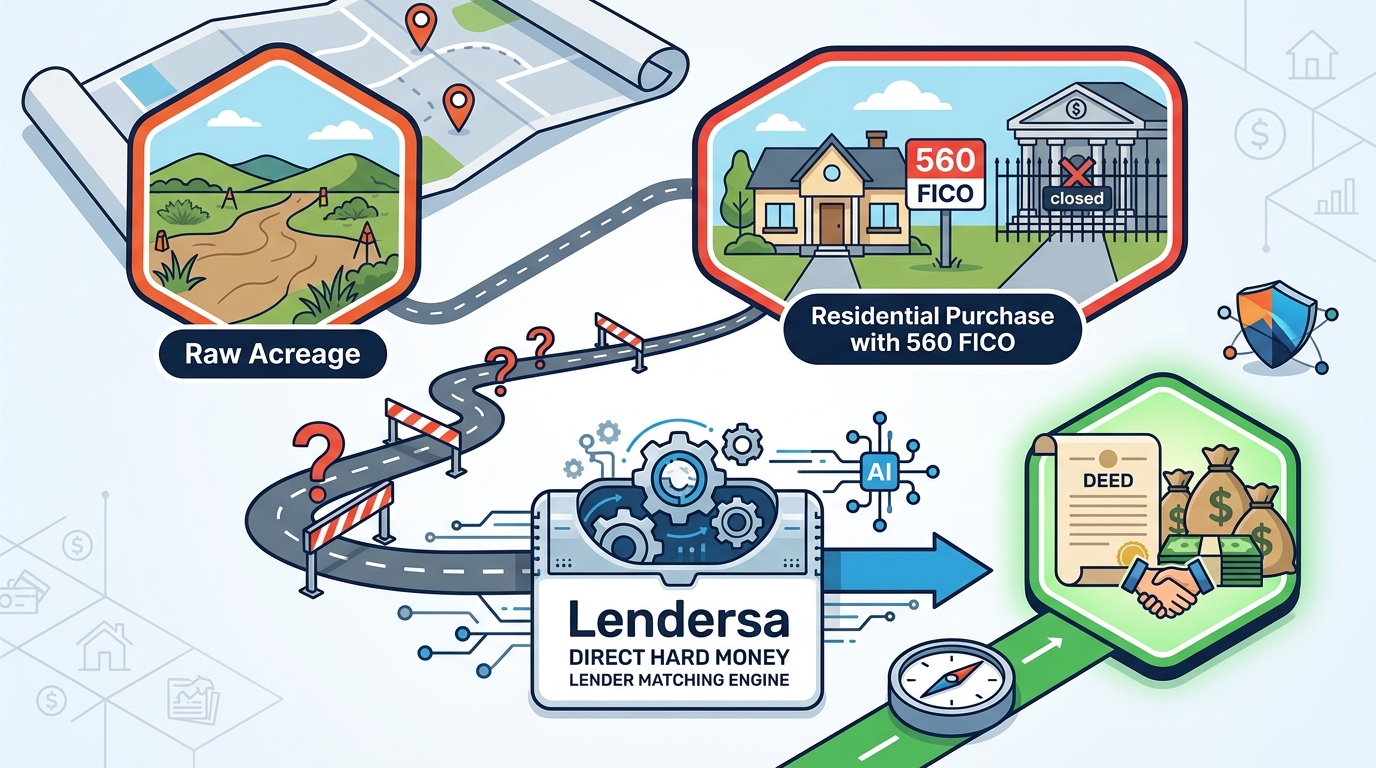
Vacant Land and Subprime Residential Loans: A Borrower's Roadmap to Direct Hard Money Lenders in 2026
Raw acreage with no structure. A residential purchase with a
560 FICO. These two scenarios share one frustrating reality: most
conventional banks will not touch them. The solution is a direct hard
money lender—but knowing where to find one, what questions to
ask, and how to compare offers can mean the difference between a fair
deal and a costly mistake. This guide walks you through every step.
What Makes Hard Money and Subprime Loans Different
Borrowers
often conflate hard money loans with subprime mortgages, but they serve
distinct purposes. A subprime mortgage is designed for borrowers with
weakened credit histories who want a traditional homeownership
path—credit scores typically below 600 qualify a loan as subprime. A
hard money loan, on the other hand, is an asset-based instrument funded
by private investors or small lending firms, where the property's equity
matters far more than the borrower's FICO score.
Hard money
lenders usually fund loans at 40 to 70 percent of a property's appraised
value, protecting themselves in case of default. These loans are
inherently short-term—often 12 to 36 months—with the expectation that
the borrower will refinance or sell. Interest rates for hard money
typically range from 7.5 to 15 percent, which is generally higher than
even subprime mortgage rates.
Subprime mortgage rates, while
elevated compared to prime loans, can range from slightly above market
to 10 percent or more depending on the borrower's risk profile. Some
subprime fixed-rate loans can extend to 40 or even 50-year terms,
whereas hard money is structured as a bridge.
Why Banks Decline Vacant Land and Subprime Borrowers
Conventional
lenders evaluate risk through two lenses: the borrower's
creditworthiness and the collateral's income-producing potential. Vacant
land generates no rental income, has volatile appraisals, and cannot be
securitized through Fannie Mae or Freddie Mac—meaning banks have
limited secondary-market options. Subprime borrowers face a parallel
barrier: loans that don't meet Fannie Mae or Freddie Mac underwriting
guidelines are classified as non-conforming and have less secondary
market liquidity, making them unattractive to large institutions.
Additionally,
the regulatory landscape after the 2008 crisis raised the bar. Subprime
loans are now regulated by the Consumer Financial Protection Bureau
(CFPB) under the Dodd-Frank Act, requiring clear disclosure of terms and
fees, prohibition of negative amortization, and mandatory housing
counseling. These requirements, while protecting borrowers, have also
discouraged many traditional lenders from operating in the non-QM space.
7 Places to Find Direct Hard Money Lenders
1. AI-Powered Loan Marketplaces
The
fastest modern approach is an AI-driven marketplace that instantly
matches your loan request with lenders who actually fund your deal type.
Lendersa,
for example, uses AI technology to instantly match your loan request
with hundreds of direct land loan lenders and brokers specializing in
vacant land—no SSN required to start comparing. Instead of cold-calling
dozens of lenders, you submit one request and receive competing offers
side by side.
Why this matters for vacant land: proximity between
the hard money investor and the property enhances loan approval odds and
speeds up the funding process. An AI marketplace accounts for
geography, loan amount, and property type to surface lenders already
active in your target area.
2. Local Real Estate Investor Associations (REIAs)
Nearly
every major metro area in the United States has a REIA that holds
monthly meetings. Private lenders attend these events specifically to
find deals. Bring a one-page summary of your land parcel or residential
deal—including purchase price, estimated value, and your exit
strategy—and you may walk away with a term sheet the same evening. This
grassroots approach works especially well for lots under $200,000 where
institutional hard money funds may not participate.
3. Title Company and Escrow Officer Referrals
Title
officers process closings for hard money lenders every week. They know
which lenders fund quickly, which ones renegotiate at the last minute,
and which ones to avoid. Ask any title company in your county for the
names of three to five active private lenders and you will have a
curated short list that is more reliable than a random web search.
4. Mortgage Broker Networks Specializing in Non-QM
Not
every mortgage broker works with non-qualified mortgage products, but
those who do maintain relationships with dozens of private and hard
money lenders. Look for brokers who advertise non-prime, non-QM, or
alternative lending services. They can shop your deal across their
lender panel, often obtaining better terms than a borrower could
negotiate alone because of volume-based pricing.
5. Online Lender Directories and Review Platforms
Websites
that aggregate hard money lender listings by state or property type can
jumpstart your search. However, exercise caution: not every listed
lender is a direct funder. Some are brokers who add a layer of fees.
Always ask a lender whether they fund from their own balance sheet or
broker to a third party.
6. Real Estate Attorneys and CPA Referrals
Attorneys
who handle commercial closings and CPAs who advise real estate
investors often have private clients looking to deploy capital as hard
money loans. These referral relationships tend to produce lenders with
more flexible terms because the deals are sourced through trusted
intermediaries rather than mass marketing.
7. County Recorder and Public Deed Records
This
is the most overlooked strategy. Visit your county recorder's office
(or its online portal) and search recent deed-of-trust recordings for
private lenders. When a hard money lender funds a deal, their name
appears on the deed of trust. Compile a list of names and contact them
directly. You now have proof that they are active, direct funders in
your exact market.
Typical Terms You Should Expect
Parameter
Vacant Land Hard Money
Subprime Residential
Interest Rate
9%–15%
8%–12%+
Loan-to-Value (LTV)
40%–65%
65%–80%
Term Length
6–24 months
15–50 years
Origination Fee
2–5 points
1–3 points
Minimum Credit Score
Often none
Typically below 620
Closing Speed
5–14 days
30–60 days
Prepayment Penalty
Varies
Prohibited under CFPB rules
For
vacant land specifically, expect lenders to require a larger down
payment—often 35 to 60 percent of the purchase price—because undeveloped
parcels are harder to liquidate. Some hard money lenders also require a
clear exit strategy (construction timeline or resale plan) before they
will commit capital.
Red Flags and Borrower Protections
Upfront fees before approval:
Legitimate hard money lenders may charge an appraisal deposit, but
large upfront fees before any underwriting begins are a warning sign.
No physical office or verifiable track record: Ask for references from recent borrowers and confirm the lender's funding history through county records.
Vague rate locks: Get every term in writing—rate, points, extension fees, and default provisions—before you pay for an appraisal.
CFPB protections for subprime residential:
If you are obtaining a subprime residential mortgage (owner-occupied),
federal rules require the lender to clearly disclose the APR and payment
schedule, refrain from issuing loans with negative amortization, and
verify you have undergone HUD-approved housing counseling.
Decision Matrix: Hard Money vs. Subprime vs. Waiting
Scenario
Best Option
Why
Buying vacant land to build within 12 months
Hard money bridge loan
Fast close, no income verification, refinance into construction loan later
Purchasing a home with a 580 FICO and stable income
Subprime / non-QM mortgage
Long-term fixed payments, CFPB protections, lower rate than hard money
Speculative land hold with no development timeline
Wait or seller financing
Hard money's short term and high cost make a multi-year hold impractical
Fix-and-flip residential with poor credit
Hard money
Speed to close beats credit requirements; property sale repays the loan
Even a 40-point FICO improvement can save tens of thousands in interest
Key Takeaways
Hard
money lenders focus on collateral value, not credit history—making them
ideal for vacant land and subprime situations where banks say no.
AI-powered marketplaces like Lendersa let you compare hundreds of direct lenders in minutes without providing your SSN upfront.
Always verify a lender is a direct funder by checking county deed-of-trust records or asking for proof of recent closings.
Subprime
residential borrowers are protected by CFPB regulations, including
mandatory disclosure and a ban on prepayment penalties.
Hard
money rates range from 7.5% to 15%, with vacant land LTVs typically
capped at 65%. Budget accordingly and have a clear exit plan.
Local
referrals—REIAs, title officers, real estate attorneys—often surface
the most reliable and competitively priced private lenders.
Frequently Asked Questions
What is a direct hard money lender?
A
direct hard money lender is a private investor or non-bank company that
funds loans from its own capital rather than brokering to a third
party. They base approval primarily on the property's value rather than
the borrower's credit score, and can often close in as few as 5 to 14
days.
Can I get a hard money loan for vacant land?
Yes.
Many hard money lenders fund vacant land purchases, though they
typically require a lower LTV (40–65%) and a documented exit strategy
such as a construction timeline or resale plan. AI marketplaces like
Lendersa connect you with hundreds of lenders who specialize in land
loans across every U.S. state.
What credit score do I need for a subprime residential loan?
Subprime
mortgages are generally available to borrowers with FICO scores below
620. Some non-QM lenders work with scores as low as 500, though lower
scores typically result in higher interest rates and larger down payment
requirements.
How do hard money loan rates compare to subprime mortgage rates?
Hard
money loan interest rates generally range from 7.5% to 15%, while
subprime mortgage rates can range from about 8% to over 12% depending on
borrower risk. However, hard money loans are short-term (6–24 months),
so the total interest paid may actually be lower than a high-rate
subprime mortgage held for decades.
Is Lendersa a direct lender or a marketplace?
Lendersa
is a loan marketplace, not a direct lender. It uses AI to match your
loan request with hundreds of direct lenders and brokers who compete for
your deal. This competition-based model helps borrowers access better
rates and terms for conventional, hard money, residential, commercial,
and vacant land loans.
What protections exist for subprime borrowers?
The
Consumer Financial Protection Bureau (CFPB) requires subprime lenders
to clearly disclose loan terms and fees, prohibits negative amortization
and prepayment penalties, and mandates that borrowers undergo
HUD-approved housing counseling before closing.