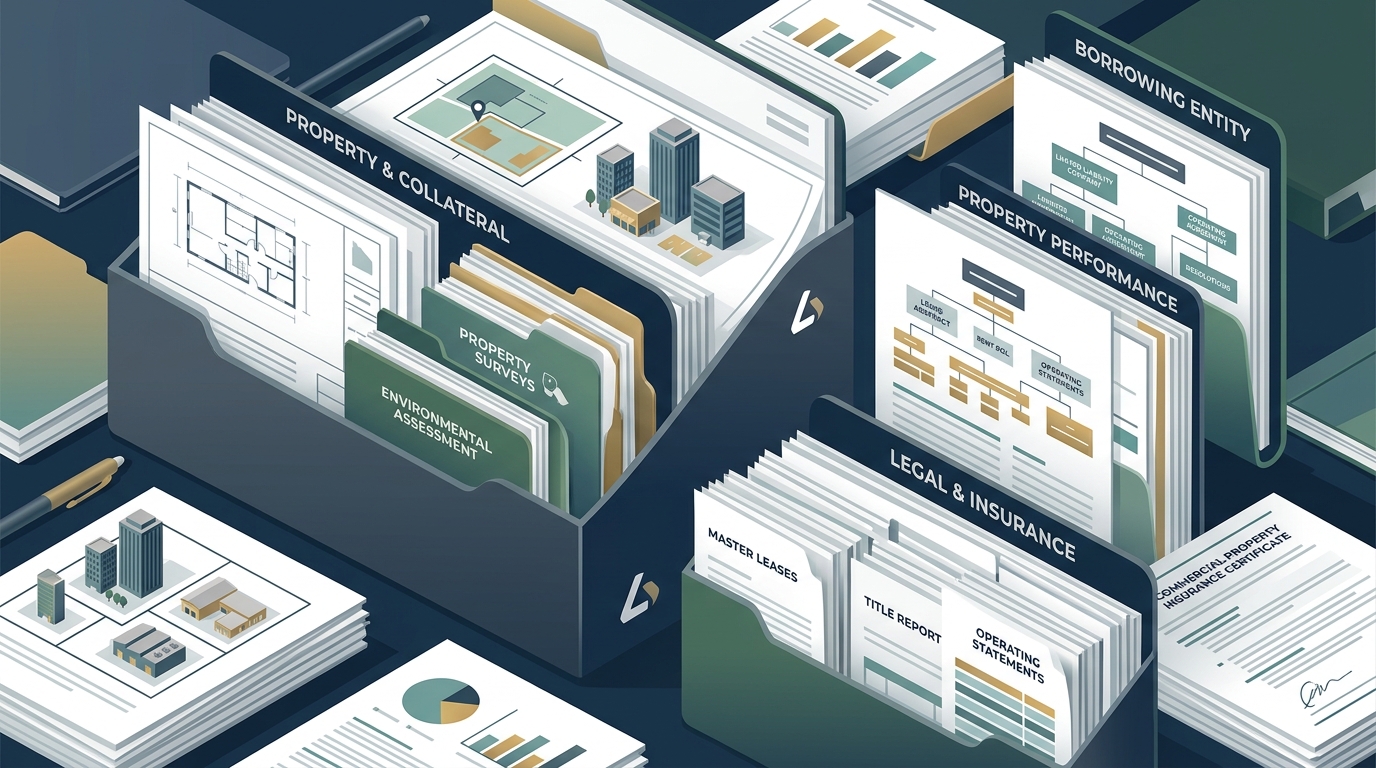
Non-Recourse Commercial Real Estate Loan Documents: What You Need Organized by Category
Non-recourse commercial real estate loans shield your personal assets
from lender claims if the deal goes south—but that protection comes at a
cost: a thick, precisely assembled document package. Unlike a standard
recourse loan where your personal guarantee backstops everything, a
non-recourse structure forces the lender to rely entirely on the
property and the borrowing entity. That means every piece of paper you
submit serves a specific risk-mitigation purpose.
This guide organizes every required document into four functional categories—Entity & Legal Structure, Property & Asset, Sponsor & Financial, and Closing & Post-Closing—so you can see why each document matters, not just that it is needed.
Why Non-Recourse Loans Demand More Paperwork
In
a recourse loan, a personal guarantee gives the lender a fallback: if
the property cannot cover the debt, they can pursue your bank accounts,
other properties, and wages. A non-recourse loan eliminates that
fallback. The lender's only avenue for repayment is the collateral
property itself and the income it generates.
Because lenders
absorb more risk, they compensate by scrutinizing every dimension of the
deal. Eligibility requirements are stricter—typically requiring Class A
or strong Class B assets, a minimum debt service coverage ratio (DSCR)
of 1.25x, and loan-to-value (LTV) ratios between 65% and 75%. The
documentation package is the mechanism through which the lender verifies
every one of these thresholds.
Category 1 — Entity & Legal Structure Documents
Non-recourse lenders almost universally require the loan to be held inside a Single Purpose Entity (SPE).
The SPE exists for one reason: to own the collateral property and
nothing else. This structure isolates the asset so that other business
liabilities cannot drag the property into an unrelated bankruptcy.
1. SPE Formation Documents
You
will submit the articles of organization (for an LLC) or certificate of
incorporation, along with the operating agreement or bylaws. Lenders
review these for bankruptcy-remote provisions—clauses requiring
unanimous consent, including from an independent director or manager,
before the entity can file for bankruptcy or dissolve.
2. Certificate of Good Standing
A
recent certificate from the state where the entity is formed proves the
SPE is active, compliant with state requirements, and authorized to
transact business.
3. Borrowing Entity Resolution
A formal
resolution from the SPE's members or board authorizing the entity to
enter into the loan, pledge the property as collateral, and designate
signatories.
4. Organizational Chart
A diagram showing
every entity and individual in the ownership chain—from the SPE at the
bottom to the ultimate beneficial owners at the top. Lenders use this to
identify related-party risks and ensure there are no undisclosed
affiliates.
Category 2 — Property & Asset Documents
Since
the property is the lender's sole recourse, they need to understand
every physical, legal, and financial attribute of the asset. This
category is the heaviest in terms of volume.
5. Commercial Appraisal
A
full appraisal conducted by a licensed MAI appraiser establishes market
value. Non-recourse lenders typically cap LTV at 65–75%, so the
appraisal directly determines how much you can borrow.
6. Rent Roll
A
current rent roll lists every tenant, their lease start and end dates,
monthly rent, any concessions, and security deposits held. Lenders use
this to model the property's cash flow and calculate DSCR.
7. Historical Operating Statements (Trailing 12 and 3-Year)
Profit
and loss statements for the most recent 12 months and the prior two to
three years demonstrate the property's income trend. Lenders
cross-reference these against the rent roll and tax returns to verify
accuracy.
8. Copies of All Existing Leases
Every executed
lease is reviewed to assess tenant quality, rollover risk, and whether
lease terms support the income assumptions in the appraisal.
9. Phase I Environmental Site Assessment
A
Phase I ESA identifies potential environmental contamination on or near
the property. If it flags recognized environmental conditions, a Phase
II assessment with soil or groundwater testing may follow. Environmental
risk is a dealbreaker because contamination can destroy collateral
value.
10. Property Condition Report (PCR)
An engineering
firm inspects the roof, HVAC, plumbing, electrical systems, and
structural elements. The PCR quantifies deferred maintenance and
estimates the cost of necessary capital improvements over the loan term.
11. Survey and Title Commitment
An
ALTA/NSPS survey shows property boundaries, easements, and
encroachments. The title commitment from a title company confirms
ownership, existing liens, and any exceptions that must be resolved
before closing.
12. Zoning Compliance Letter or Certificate of Occupancy
Verifies
that the property's current use conforms to local zoning ordinances. A
non-conforming use can impair collateral value if the building is
destroyed and cannot be rebuilt.
13. Insurance Certificates
Proof
of property insurance, general liability, and—where applicable—flood,
earthquake, or environmental liability coverage. Policies must name the
lender as an additional insured or loss payee.
Category 3 — Sponsor & Financial Documents
Even
though the loan is non-recourse, lenders still underwrite the sponsor.
They need confidence that the person or group controlling the property
has the experience and liquidity to manage the asset well and avoid
triggering bad-boy carve-outs.
14. Personal Financial Statement (PFS)
A
current PFS for each key principal, listing assets, liabilities, and
net worth. Lenders typically require sponsors to demonstrate significant
liquidity—often six to twelve months of debt service in liquid
reserves.
15. Three Years of Personal and Business Tax Returns
Tax
returns verify income, confirm the accuracy of the personal financial
statement, and reveal any hidden liabilities or loss carryforwards.
16. Schedule of Real Estate Owned (REO)
A
detailed listing of every property the sponsor owns, including address,
property type, current loan balance, NOI, and vacancy rate. This shows
the lender how experienced the sponsor is and whether they are
overleveraged.
17. Résumé of Real Estate Experience
A
narrative or formatted CV documenting the sponsor's track record in
acquiring, operating, and disposing of similar property types.
Non-recourse lenders place heavy weight on relevant experience—a
first-time investor is unlikely to qualify without a co-sponsor.
18. Credit Authorization and Background Check Consent
While
non-recourse loans do not typically appear as personal contingent
liabilities on credit reports, lenders still pull credit to check for
bankruptcies, judgments, or derogatory marks that signal risk.
Category 4 — Closing & Post-Closing Documents
These
are the legal instruments that formalize the loan and create the
lender's security interest in the property. Many are drafted by the
lender's counsel, but the borrower must review, negotiate, and execute
them.
19. Promissory Note
The note specifies the loan
amount, interest rate, payment schedule, maturity date, and any
prepayment provisions including yield maintenance or defeasance
requirements.
20. Mortgage or Deed of Trust
This
instrument grants the lender a lien on the property. It is recorded in
the local land records office, providing public notice of the lender's
security interest.
21. Assignment of Leases and Rents
Assigns
the property's rental income to the lender as additional collateral. If
the borrower defaults, the lender can intercept rent payments directly
from tenants.
22. Environmental Indemnity Agreement
Regardless
of the non-recourse structure, nearly all lenders require an
environmental indemnity that survives foreclosure. This indemnity
typically is recourse—meaning the sponsor is personally liable for remediation costs if contamination is discovered.
23. UCC Financing Statements
Uniform
Commercial Code filings perfect the lender's security interest in
personal property associated with the real estate—fixtures, equipment,
and receivables.
24. Subordination, Non-Disturbance, and Attornment (SNDA) Agreements
These
three-party agreements between the lender, borrower, and major tenants
ensure that existing leases survive a foreclosure, protecting the income
stream that secures the loan.
25. Estoppel Certificates
Signed
statements from tenants confirming lease terms, rent amounts, and that
the landlord is not in default. Lenders rely on these to validate the
rent roll at closing.
The Carve-Out Guaranty: The Document That Can Undo Non-Recourse Protection
No discussion of non-recourse loan documents is complete without addressing the non-recourse carve-out guaranty,
sometimes called the "bad boy guaranty." This single document is
arguably the most important in the entire package because it defines
exactly when your personal liability shield disappears.
Almost all
institutional lenders require a creditworthy individual—usually the
controlling principal of the borrowing entity—to sign this guaranty. It
creates personal liability for specific "bad acts" that could harm the
lender's collateral position.
Common Triggers That Activate Full Recourse
Filing for voluntary bankruptcy or colluding in an involuntary filing
Fraud or intentional misrepresentation during the loan application
Unauthorized transfer of the property or ownership interests
Common Triggers That Create Loss-Based Liability
Misappropriation of rents, security deposits, or insurance proceeds
Failure to pay property taxes resulting in tax liens
Failure to maintain required insurance coverage
Environmental contamination or waste of the property
Refusing to permit lender property inspections
The critical distinction is whether a violation makes the guarantor liable for the lender's actual losses or for the entire outstanding loan balance.
Some lender forms list as few as three or four trigger acts, while
others list fifteen to twenty. Always have your attorney review and
negotiate this document before signing.
Practical Tips for Assembling Your Package
Start the SPE before you find the property.
Formation documents take time to prepare correctly, especially
bankruptcy-remote provisions. Having the entity ready eliminates weeks
of delay.
Order the Phase I ESA and appraisal early.
These are the two longest lead-time items, often requiring four to six
weeks. Environmental surprises discovered late can kill a deal.
Keep a living rent roll. Update it monthly. Lenders will ask for a current version at application, again during underwriting, and once more at closing.
Pre-draft estoppel certificates and SNDA agreements.
Getting tenant signatures takes longer than borrowers expect,
especially with national credit tenants whose legal teams have their own
review cycles.
Maintain a digital document room.
Organize files by the four categories outlined above. Underwriters who
can find what they need quickly are more likely to issue favorable
terms.
Negotiate the carve-out guaranty as aggressively as the interest rate.
Request cure periods for operational carve-outs like tax payments or
inspections, and push for loss-based (rather than full-balance)
liability wherever possible.
How Lendersa Helps You Navigate Documentation
Preparing
a non-recourse document package can feel overwhelming, especially when
different lenders—CMBS conduits, life insurance companies, private
lenders—each have variations on what they expect. Lendersa
simplifies this by letting you submit your deal once and receive
competing offers from multiple lenders. The platform's AI matching
engine identifies which lenders are the best fit for your property type,
loan size, and experience level—so you spend time preparing documents
for lenders who are genuinely interested in your deal, not chasing dead
ends.
Whether you are financing a stabilized multifamily asset, a
retail center, or an industrial property, Lendersa connects you with
conventional and hard money lenders who offer non-recourse structures.
You can start comparing options without providing a Social Security
number, which means you can gauge your document requirements before
committing to a full application.
Frequently Asked Questions
What is a non-recourse commercial real estate loan?
A
non-recourse commercial real estate loan is a secured loan where the
lender's recovery in the event of default is limited to the collateral
property. The lender cannot pursue the borrower's personal assets, bank
accounts, or other properties to cover a shortfall.
Do I still need to provide personal financial information for a non-recourse loan?
Yes.
Even though the loan is non-recourse, lenders still underwrite the
sponsor. They review personal financial statements, tax returns, credit
history, and real estate experience to ensure the borrower can
competently manage the property and is unlikely to trigger carve-out
violations.
What is a bad boy carve-out guaranty?
A bad
boy carve-out guaranty is a document signed by the loan's
guarantor—typically the controlling principal—that creates personal
liability for specific misconduct such as fraud, voluntary bankruptcy,
misappropriation of rents, or failure to maintain insurance. It is
standard on virtually all non-recourse commercial loans.
How long does it take to close a non-recourse commercial real estate loan?
Non-recourse
commercial real estate loans typically take 45 to 90 days to close,
compared to 30 to 60 days for conventional recourse commercial loans.
The additional time reflects more extensive underwriting, environmental
assessments, and SPE documentation requirements.
What is a Single Purpose Entity and why is it required?
A
Single Purpose Entity (SPE) is an LLC or corporation formed solely to
own the collateral property. Lenders require SPEs to isolate the asset
from the borrower's other business activities and debts, making it
harder for the entity to be pulled into an unrelated bankruptcy
proceeding.
Can a non-recourse loan become a recourse loan?
Yes.
If the borrower or guarantor violates any of the carve-out
provisions—such as committing fraud, filing for voluntary bankruptcy, or
misappropriating property income—the non-recourse protection can be
partially or fully stripped away, making the guarantor personally
liable.
What minimum property qualifications are needed for non-recourse financing?
Most
non-recourse lenders require a DSCR of at least 1.25x, an LTV between
65% and 75%, and a stabilized, income-producing property. Class A or
strong Class B assets in major metropolitan areas are preferred.
How can Lendersa help me find a non-recourse lender?
Lendersa
is an AI-powered loan marketplace that matches your deal with competing
lenders. You enter your property details once and receive offers from
conventional and hard money lenders offering non-recourse structures—no
SSN required to start comparing.
Key Takeaways
Non-recourse
CRE loans require documents across four categories: entity structure,
property asset, sponsor financial, and closing legal instruments.
A Single Purpose Entity with bankruptcy-remote provisions is a baseline requirement for nearly all non-recourse lenders.
The carve-out guaranty is the single most consequential document—it defines when your non-recourse protection disappears.
Environmental indemnity is almost always carved out as a recourse obligation, even on otherwise non-recourse loans.
Closing timelines run 45–90 days, so order long-lead items like Phase I ESAs and appraisals immediately.
Lendersa lets you compare non-recourse loan offers from multiple lenders with one submission, streamlining the process.